
Japanese White Pine (Pinus parviflora)
Pinus parviflora is a perennial evergreen coniferous tree, with a denser, conical crown when young that can become flatter and irregular with age.
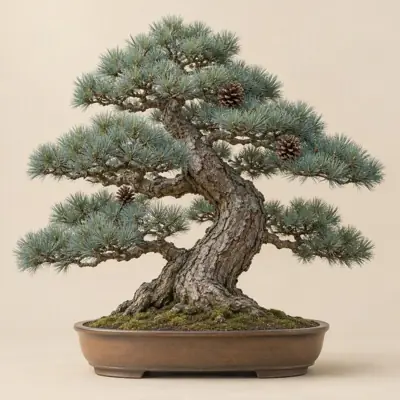
Overview
Pinus parviflora is a perennial evergreen coniferous tree, with a denser, conical crown when young that can become flatter and irregular with age.
Origin and habitat
Sources differ on its native range: it is primarily native to Japan, while some horticultural and botanical sources also include South Korea; records occur across several parts of Japan and also include a Korean island population. It occurs in mountain environments, often on sunny rocky slopes or hillsides. Its habitat has a temperate mountain climate, and the plant is cold-tolerant.
Characteristics
Sources differ on mature height, giving a range of about 1500–2500 cm; sources are few for mature spread, reported at about 400–800 cm. Sources differ in describing growth as slow to moderate, with some explicitly describing it as slow; the needles are typically borne in bundles and are often blue-green to gray-blue. The species is monoecious; it is reported to bear male reproductive structures on the lower parts of current growth and female reproductive structures at the tips of new shoots, with pollen dispersed by wind, and its reproductive season is in spring. The cones are generally ovoid to elliptic-ovoid with broad, rounded seed scales, while the seeds have short or reduced wings.
Light
Pinus parviflora grows in full sun.
Watering
Good drainage is important; mature plants tolerate drought, while persistently poorly drained soil is unsuitable.
Temperature and dormancy
Based on few sources, the reported minimum temperature is about -25 °C.
Growing medium and mounting
It requires well-drained soil and can be grown in clay, loam, or sand with acidic, neutral, or alkaline pH; moist podzol is also recorded in the wild.
Propagation
It is reported to be propagated from seed, with RHS recommending sowing in containers in late winter and keeping them in a cold frame, followed by keeping the young plants in pots.
Common problems
It is reported to be susceptible to adelgids, conifer aphids, sawfly larvae, and pine shoot moths. It is reported to be susceptible to honey-fungus-related disease and needle cast. Poor drainage is unfavorable for growth, and hot, highly humid conditions may result in unhealthy growth. Strong winds may cause damage, while fully dormant plants have considerable cold tolerance.
Identification
Notable identifying features include bundled blue-green to gray-blue needles, cones with broad rounded seed scales, and a crown that changes from dense and conical when young to flatter and irregular with age.
Photos


Sources
- Wikipedia (en): Pinus parviflora — CC BY-SA 4.0 · link
- 維基百科:日本五针松 — CC BY-SA 4.0 · link
- Wikipedia (ja): ゴヨウマツ — CC BY-SA 4.0 · link
- Wikipedia (de): Mädchen-Kiefer — CC BY-SA 4.0 · link
- Wikipedia (fr): Pin blanc du Japon — CC BY-SA 4.0 · link
- Wikipedia (es): Pinus parviflora — CC BY-SA 4.0 · link
- GBIF descriptions: The Woody Plants of Korea (한국의 수목) — per dataset · link
- NC State Plant Toolbox: Pinus parviflora — copyright (facts only) · link
- Useful Tropical/Temperate Plants: Pinus parviflora — CC BY-NC-SA 3.0 (facts only) · link
- RHS Plants: Pinus parviflora — © RHS, facts only · link