
Butterworts (Pinguicula × weser)
Pinguicula is reported to consist of small carnivorous herbs whose species form basal rosettes without an obvious stem and generally have poorly developed root systems. Sources differ, but most are described as perennial herbs and a minority as annuals; listed annual species include P. sharpii, P. takakii, P. crenatiloba, and P. pumila.
Overview
Pinguicula is reported to consist of small carnivorous herbs whose species form basal rosettes without an obvious stem and generally have poorly developed root systems. Sources differ, but most are described as perennial herbs and a minority as annuals; listed annual species include P. sharpii, P. takakii, P. crenatiloba, and P. pumila.
Origin and habitat
Sources differ on the details of the range, but Pinguicula is described as widespread from temperate to cold regions of the Northern Hemisphere and across the Americas, including Europe, North America, Central America, South America, the Caribbean, northern Eurasia, the Himalayas, and southwestern and central China; multiple sources indicate that many species occur in Central and South America. It is reported to grow in wet meadows, damp rock faces or rocky ground, moist ground, near streams, and in peatlands; some habitats have nutrient-poor soils, and some species occur on seeping calcareous rock. The genus is reported to include tropical and temperate types; temperate types are adapted to climates with cold winters and often form overwintering buds, while tropical types do not undergo typical winter dormancy and may continue changing rosette forms and flowering.
Characteristics
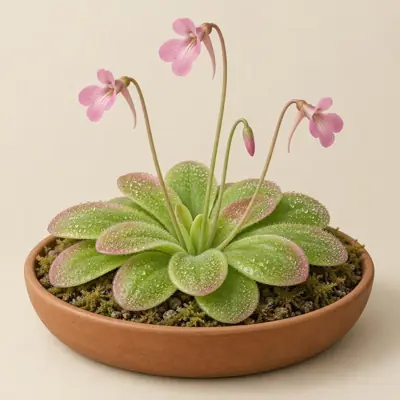
Leaves are reported to form basal rosettes and to be somewhat thick or fleshy, with dense glands or glandular hairs that secrete mucilage and trap small insects; some species seasonally switch between rosettes with carnivorous and non-carnivorous leaves. Flowers are reported to be borne on stalks arising from the center of the rosette and to have a spurred corolla; one source describes a divided upper lip and a larger, divided lower lip, while another reports flowers that may be white, blue, or pink and less commonly yellow or orange-red. Temperate types are reported to flower while forming their summer rosettes, with another source describing flower stalks emerging from the plant center in spring; tropical types may flower during rosette transitions.
Light
Pinguicula is reported to grow in full sun to partial sun. Its light need is reported as full sun.
Watering
Sources differ on water needs by ecological type: Pinguicula is commonly recorded in moist environments, but some tropical species occur where water is seasonally limited, and excessively wet soil may cause rot. It is generally recommended to keep evenly moist.
Temperature and dormancy
Pinguicula is reported to be frost hardy. Sources differ because dormancy varies.
Growing medium and mounting
Pinguicula is reported to grow in sphagnum moss or in a medium combining peat or coconut fiber with coarse vermiculite or coarse sand; it can grow in nutrient-poor environments.
Feeding
Pinguicula is reported to capture and digest insects with sticky glandular leaves, supplementing mineral nutrients that are scarce in its environment.
Common problems
Some tropical Pinguicula are reported to rot when the soil is excessively wet. Horticultural sources are reported not to list specific insect pest problems. Responses to seasons and low temperatures are reported to vary by ecological type: temperate types form overwintering buds and enter dormancy during cold winters, while tropical types generally do not undergo this form of winter dormancy.
Identification
Pinguicula is reported to have sticky glands on its leaves that form a passive, flypaper-like trapping surface, capturing and digesting small insects to supplement mineral nutrients lacking in nutrient-poor environments.
Photos


Sources
- Wikipedia (en): Pinguicula — CC BY-SA 4.0 · link
- 維基百科:捕蟲堇屬 — CC BY-SA 4.0 · link
- Wikipedia (ja): ムシトリスミレ属 — CC BY-SA 4.0 · link
- Wikipedia (de): Fettkräuter — CC BY-SA 4.0 · link
- Wikipedia (fr): Grassette — CC BY-SA 4.0 · link
- Wikipedia (es): Pinguicula — CC BY-SA 4.0 · link
- Wikipedia (it): Pinguicula — CC BY-SA 4.0 · link
- NC State Plant Toolbox: Pinguicula (genus-level) — copyright (facts only) · link