
Pinguicula hybrid (Pinguicula hybrid)
Pinguicula hybrida is reported to be a carnivorous herb that forms a stemless basal rosette. Sources differ in describing its life cycle, including an account describing it as perennial.
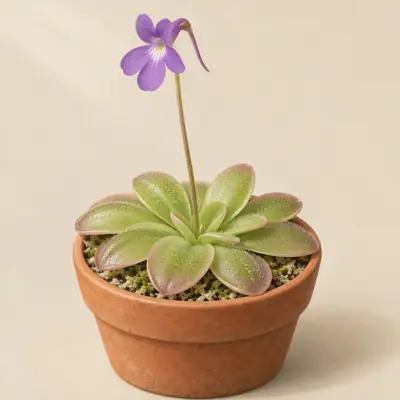
Overview
Pinguicula hybrida is reported to be a carnivorous herb that forms a stemless basal rosette. Sources differ in describing its life cycle, including an account describing it as perennial.
Origin and habitat
Sources differ on the range described for Pinguicula: accounts describe the genus as widespread in the Northern Hemisphere, with species diversity especially concentrated in Mexico, Central America, and South America, while another account describes it as widespread across much of the world except Australia. The genus is reported to occur commonly in nutrient-poor habitats that remain wet during growth, including wetlands, peatlands, rock faces, and mossy slopes, with some species occurring on gypsum soils or in epiphytic habitats. Pinguicula is reported to include tropical and temperate types; tropical types generally lack winter dormancy, while temperate types can form dormant winter buds.
Characteristics
A single source reports a mature height of about 5.08–30.48 cm and a mature spread of about 2.54–15.24 cm, so sources are few for these ranges; growth is reported to be slow. Leaves are reported to be simple and arranged in a basal rosette, with smooth surfaces bearing small glands that secrete mucilage to capture small insects; within the genus, foliage can be green, yellow-green, pink, or purple in tone, and leaf shape varies by species. Flowers are generally solitary on slender stalks rising above the rosette, bilaterally symmetrical, and spurred behind the corolla; colors reported within the genus include blue, purple, or white, sometimes with yellow, green, or red tones, and flowering is reported in spring. The fruit is reported to be a capsule that dries at maturity and splits into halves, containing many small brown seeds.
Light
It is reported to grow from full sun to partial sun, while many species in the genus can also grow with partial sun or in shadier conditions. Medium light is reported as its light need.
Watering
During growth, the soil is reported to remain consistently moist; most species in the genus need nearly continuous damp or wet conditions while carnivorous leaves are growing, although some types can shift to drought-tolerant non-carnivorous leaves or dormant structures during a winter dry period. The reported moisture target is to keep wet.
Temperature and dormancy
A USDA hardiness-zone classification is reported for Pinguicula hybrida.
Growing medium and mounting
A nutrient-poor medium that stays moist is reported; container media can use long-fiber sphagnum moss or a mixture of equal parts peat or coconut fiber and coarse vermiculite or coarse sand, while natural habitats across the genus include alkaline soils, acidic peat, and gypsum substrates. Sphagnum moss is reported as a substrate type.
Feeding
Pinguicula is reported to use sticky leaves to passively capture prey, digest it, and absorb its nutrients.
Propagation
Propagation is reported to be possible from seed, while many Pinguicula species can also reproduce asexually through vegetative means such as offsets.
Common problems
The source reports no specific pest problems and no specific disease problems. Some tropical Pinguicula are reported to be susceptible to rotting when the soil is excessively wet. Responses to seasonal moisture conditions are reported to vary by type; some Mexican species form succulent non-carnivorous leaves or dormant structures during the winter dry period.
Identification
Leaf-surface glands are reported to form a sticky trapping surface that holds prey and secretes digestive enzymes, after which the leaf surface absorbs the resulting nutrients.