
Giant Butterwort (Pinguicula gigantea)
Pinguicula gigantea is a perennial herb that grows in clustered basal rosettes.
Overview
Pinguicula gigantea is a perennial herb that grows in clustered basal rosettes.
Origin and habitat
Sources differ in their accounts of its native range, describing Mexico and, more specifically, the area around San Bartholomé Ayautla in Oaxaca, Mexico. It is reported to occur on steep slopes in full sun around San Bartholomé Ayautla in Oaxaca. It is reported to inhabit a tropical Mexican environment with very little winter rainfall, where dry conditions trigger seasonal dormancy.
Characteristics
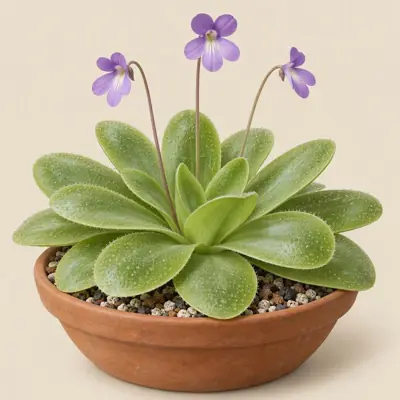
Few sources indicate a mature height of about 10–50 cm. Sources differ on mature spread, with the available range being about 10–50 cm. It is reported to form large, flat basal rosette leaves that range from elongated-elliptic to obovate, with rounded to blunt tips; both leaf surfaces bear glandular hairs that secrete mucilage and can trap small insects. The flowers are reported to be usually bilaterally symmetrical, chiefly pale to deep purple, with pale blue, blue, and white forms also occurring, and each flower stalk bears a single terminal flower; flower stalks form during part of the year, and new leaves and flowers appear after growth resumes from dormancy in spring.
Light
Sources describe light requirements differently, ranging from full sun to bright filtered light, with bright filtered light also used in cultivation. It is generally described as needing full sun.
Watering
Keep the growing medium moist but well drained; water can be plentiful during active growth and should be reduced in winter, while dry winter conditions in its native habitat and insufficient moisture promote dormancy. It is generally recommended to keep evenly moist.
Temperature and dormancy
Dormancy is reported to vary.
Growing medium and mounting
Pinguicula gigantea prefers a well-drained growing medium; RHS suggests a mixture in equal proportions of specialist peat-free medium, coarse sand, horticultural grit, and dolomitic limestone chips, and lists sandy and chalky soil types with neutral to alkaline pH.
Propagation
It can be propagated from seed or leaf cuttings; seeds may be sown on moist sphagnum after ripening, while leaf cuttings can be taken in late winter. Sources indicate that propagation from seed is slower, while leaf cuttings take less time to produce mature plants.
Common problems
It is generally reported to have few pest problems and few disease problems. RHS is reported to recommend a sheltered growing position and provides a hardiness rating for the plant.
Identification
It is reported to have exceptionally large leaves for its genus; unlike most members of the genus, both the upper and lower leaf surfaces bear sticky glands capable of trapping prey.
Photos

