
Pinguicula esseriana (Pinguicula esseriana)
Pinguicula esseriana is a small, clump-forming carnivorous herb whose leaves form rosettes. It is reported to be perennial.
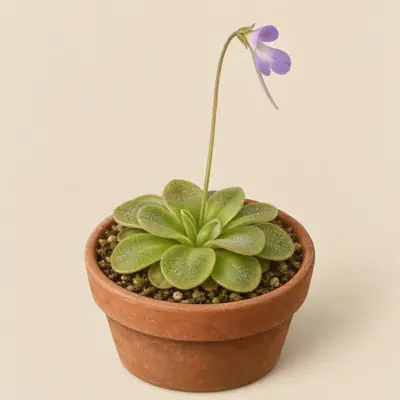
Overview
Pinguicula esseriana is a small, clump-forming carnivorous herb whose leaves form rosettes. It is reported to be perennial.
Origin and habitat
Pinguicula esseriana is native to Mexico, with the RHS further recording it from San Luis Potosí. It is reported to inhabit tropical habitat. It is reported to be native to tropical environments while having some frost tolerance.
Characteristics
Few sources report a mature height of about 0–10 cm and a mature spread of about 0–10 cm. It is reported to grow relatively slowly and to flower in spring, producing capsules. The leaves have sticky carnivorous surfaces; leaves in the genus Pinguicula are typically arranged in basal rosettes and bear tiny glands that trap and digest small insects. Pinguicula typically has solitary flowers borne above the foliage on slender flower stalks, with blue, purple, and white among the flower colors found within the genus.
Light
Sources describe the light requirement differently: one account reports bright, filtered light, while other evidence indicates full sun.
Watering
Sources differ on watering guidance; one account calls for ample water during growth, reduced watering in winter, and a moist but well-drained medium. It is generally reported to be kept slightly drier during rest.
Temperature and dormancy
Hardiness information includes RHS H1C, while genus-level Pinguicula information also lists USDA 8a–11b. Pinguicula esseriana is reported to be frost hardy.
Growing medium and mounting
Sources differ on the growing medium: one account describes a mixture of equal proportions of specialist peat-free medium, coarse sand, horticultural grit, and crushed dolomitic limestone, while also listing sandy or chalky soil and neutral to alkaline, moist, well-drained conditions. Sphagnum moss is also reported as a substrate type.
Feeding
Small insects are reported to be trapped and digested by the leaves, providing nutrients to the plant in nutrient-poor environments.
Propagation
It is reported that mature seed can be sown immediately on moist sphagnum moss and that leaf cuttings can be taken in late winter.
Common problems
Pinguicula esseriana is generally reported to have few pest or disease problems. The RHS recommends a sheltered growing position, while another source notes frost tolerance despite the species occurring in tropical habitat.
Identification
Pinguicula esseriana is a small carnivorous plant distinguished by leaf surfaces with sticky glands that trap and digest insects.
Photos

