
golden polypody (Phlebodium aureum)
Phlebodium aureum is a perennial epiphytic fern with a creeping rhizome, though it may occasionally grow terrestrially or on rocks and is commonly cultivated as an indoor foliage plant. It is evergreen, but in regions with a pronounced dry season it may be semi-evergreen or briefly deciduous.
Overview
Phlebodium aureum is a perennial epiphytic fern with a creeping rhizome, though it may occasionally grow terrestrially or on rocks and is commonly cultivated as an indoor foliage plant. It is evergreen, but in regions with a pronounced dry season it may be semi-evergreen or briefly deciduous.
Origin and habitat
Sources differ on its native range, which is described as spanning tropical and subtropical parts of the Americas from southernmost Florida and Georgia through Mexico, Central America and the Caribbean to South America, with southern limits reported in Brazil, Paraguay and Argentina. It grows mainly as an epiphyte in tropical rainforest canopies, on trunks and palms, but may also grow terrestrially or on moss-covered rocks, occurring in forests, cloud forests and some wetlands. It occurs in tropical to subtropical climates, favors humid forest environments and has low frost tolerance.
Characteristics
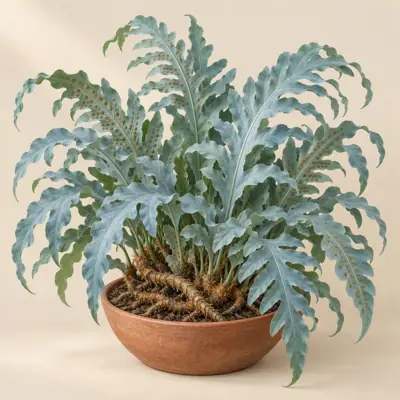
Mature plants reach 50–152.4 cm in height, while their spread is reported at about 10–50 cm, although sources are few. Sources differ in describing the large, deeply pinnatifid to pinnately divided, wavy-edged fronds, whose color ranges from bright green to blue-green or gray-green; 'Davana' is described as compact, with powdery blue-toned fronds and wavy margins. The plant has a creeping rhizome.
Light
Part sun, shade, or a bright position out of direct sunlight is suitable; light that is too weak or too strong may limit or damage growth.
Watering
Keep the growing medium evenly moist but not waterlogged, watering thoroughly as it begins to dry; slight drying between waterings can be tolerated.
Humidity and airflow
It is generally reported to prefer high humidity and need good airflow, with a high humidity need.
Temperature and dormancy
A minimum around 5 °C is reported, but sources are few. Hardiness information places it in USDA zones and an RHS hardiness category, and it is described as tender. It is generally reported to be frost tender and should be kept above freezing.
Growing medium and mounting
A loose, organically rich, well-drained medium that retains moderate moisture is suitable; sources differ on the preferred medium reaction and type, with NC State recommending acidic conditions while RHS lists loam and neutral pH.
Propagation
Phlebodium aureum can be propagated by division, including by dividing the rhizome, while wild plants also reproduce by tiny wind-dispersed spores. The tiny spores are reported to disperse on the wind and may sometimes self-sow into pots containing other indoor plants.
Common problems
It is reported to be susceptible to spider mites, thrips, Florida fern caterpillar and fungus gnats. Sources differ on disease occurrence: crown and root rots may occur, while RHS describes the species more generally as usually having few diseases. Browning fronds are reported to be associated with insufficient air humidity, while curling may be associated with low humidity or lack of water; overly wet growing medium is associated with risk of crown and root rot. It does not tolerate prolonged or severe frost, and cold drafts and excessively low nighttime temperatures should be avoided.
Identification
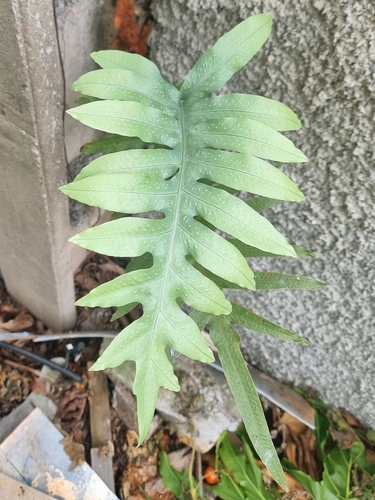
Phlebodium aureum has a creeping rhizome densely covered with golden-brown scales, deeply divided fronds often colored blue-green to gray-green, and round sori arranged on either side of the pinna midribs on mature fronds. 'Davana' is distinguished by its compact form, powdery blue tone and conspicuously wavy frond margins.
Photos



Sources
- GBIF Backbone: Phlebodium aureum (L.) J.Sm. — CC BY 4.0 · link
- Wikipedia (en): Phlebodium aureum — CC BY-SA 4.0 · link
- Wikipedia (de): Goldtüpfelfarn — CC BY-SA 4.0 · link
- Wikipedia (es): Phlebodium aureum — CC BY-SA 4.0 · link
- NC State Plant Toolbox: Phlebodium aureum — copyright (facts only) · link
- Useful Tropical/Temperate Plants: Phlebodium aureum — CC BY-NC-SA 3.0 (facts only) · link
- RHS Plants: Phlebodium aureum — © RHS, facts only · link
- USDA PLANTS Database: Phlebodium aureum — Public domain (US Government work) · link
- Top Tropicals catalog: Phlebodium aureum — © Top Tropicals LLC (facts only) · link