
Ecuador philodendron (Philodendron verrucosum)
Philodendron verrucosum is a climbing plant that is usually a semi-epiphyte, less often terrestrial or epiphytic, and can climb along supports.
Watch: Monstera vs Philodendron vs Alocasia vs Anthurium
Overview
Philodendron verrucosum is a climbing plant that is usually a semi-epiphyte, less often terrestrial or epiphytic, and can climb along supports.
Origin and habitat
Sources differ on its native range, which is described as extending from Costa Rica to Peru and including Costa Rica, Panama, Colombia, Ecuador, and Peru. Sources differ on habitat details: it occurs mainly in foothill and tropical lower montane rainforest and also in tropical wet forest, with Central American records mainly on the Atlantic side or near the central divide and South American records on the Pacific side of the Andes and some eastern slopes. Its environment is tropical wet to lower montane rainforest, with warm, humid conditions and intolerance of frost.
Characteristics
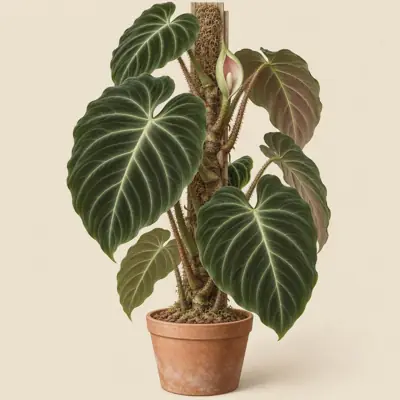
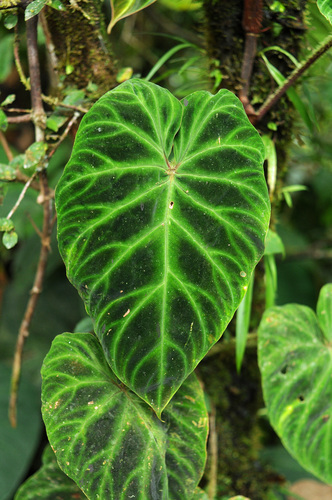
The leaves are broadly ovate to heart-shaped, dark green to bronze-green, and velvety to matte, with conspicuous paler veins; the undersides may be reddish purple to burgundy, and new leaves may show a stronger reddish-purple tone. It is reported to produce inflorescences in the leaf axils, with spathes that may be medium green, white-green, or red-green outside and white to pink inside; the spathe tube may be red-green, medium green, or dark violet outside and red or pale red inside, while the spadix has female-flower and male-flower zones. The berries are reported to be white when the fruiting structure matures.
Light
Sources differ in describing its light conditions as bright indirect light to partial shade, while recommending avoidance of strong direct sunlight. It is generally described as suited to bright indirect light.
Watering
It is reported to benefit from regular watering in a moist but well-drained medium; water can be applied thoroughly with excess allowed to drain, and the surface may dry slightly before watering again.
Humidity and airflow
It is generally reported to prefer high humidity.
Temperature and dormancy
It is generally described as frost tender; keep above freezing.
Growing medium and mounting
It is generally recommended to use an organic-rich, well-drained medium, with a slightly acidic medium recommended after division.
Feeding
During the growing season, dilute liquid fertilizer can be applied regularly, and genus-level information likewise recommends regular feeding during active growth.
Propagation
Sources differ on propagation information: Philodendron verrucosum can be propagated by dividing mature plants, while genus-level information also describes stem cuttings and layering for Philodendron.
Common problems
In cultivation, Philodendron is generally reported to be susceptible to scale insects, spider mites, aphids, thrips, and slugs. Genus-level cultivation information generally records soft rot, leaf rot, leaf spot, and root rot associated with overwatering in Philodendron. Overwatering may cause root rot, strong direct light may scorch the leaves, and the leaf surface is susceptible to scratches and can be damaged during cleaning. It is sensitive to frost and should be kept from freezing conditions; Philodendron is also described at genus level as sensitive to low temperatures and cold drafts.
Identification
Philodendron verrucosum is distinguished by large, dark green, velvety leaves with conspicuous pale veins, often reddish-purple undersides, and petioles densely covered with scales and long, slender bristles.
Photos



Sources
- GBIF Backbone: Philodendron verrucosum L.Mathieu ex Schott — CC BY 4.0 · link
- Wikipedia (en): Philodendron verrucosum — CC BY-SA 4.0 · link
- GBIF descriptions: Catálogo de Plantas y Líquenes de Colombia; Plantas vasculares que se han reportado en los bosques s — per dataset · link
- NHK みんなの趣味の園芸 植物図鑑: Philodendron (genus-level) — © NHK出版, facts only · link
- NC State Plant Toolbox: Philodendron (genus-level) — copyright (facts only) · link
- Top Tropicals catalog: Philodendron verrucosum — © Top Tropicals LLC (facts only) · link