
Philodendron tortum (Philodendron tortum)
Philodendron tortum is an evergreen perennial herbaceous vine and a root climber with aerial roots that can attach to tree trunks or other supports as it grows upward.
Watch: Monstera vs Philodendron vs Alocasia vs Anthurium
Overview
Philodendron tortum is an evergreen perennial herbaceous vine and a root climber with aerial roots that can attach to tree trunks or other supports as it grows upward.
Origin and habitat
Sources differ on its native range, describing it from Brazil and Bolivia, with Brazilian records specifically including Amazonas. It occurs in humid tropical forest and climbs tree trunks as a root climber, with records from both humid lowland and upland forest environments. Its environment is warm, humid, and tropical.
Characteristics
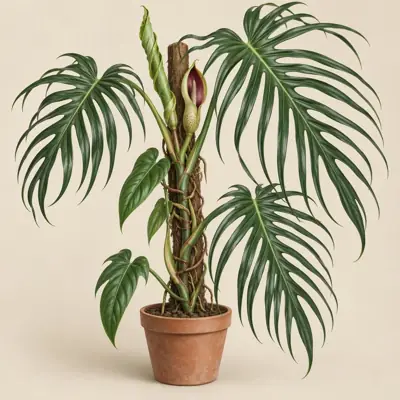
The leaves are deeply pinnately divided, with mature leaves bearing numerous narrow, often twisted or curved lobes; young leaves may have red, pink, or copper tones before maturing to green or dark green. The inflorescence consists of a spathe and spadix; the spathe is pale green with darker stripes when immature, becomes green and may develop red spots at maturity, and is purplish red inside, while flowering is less common in cultivation. A source reports no infructescence in the records it describes.
Light
Philodendron tortum grows in partial sun to bright filtered light, and plants that have not been acclimated should avoid sudden exposure to strong full sun because the leaves may scorch. It is generally suited to bright indirect light.
Watering
Water after the growing medium dries, maintaining regular, moderate moisture while keeping the roots aerated and avoiding waterlogging; genus-level Philodendron guidance also recommends watering during the growing season when the surface of the potting medium begins to dry.
Humidity and airflow
Philodendron tortum is generally reported to prefer high humidity.
Temperature and dormancy
A single source suggests a minimum temperature of about 10 °C. It is generally described as frost tender and should be kept above freezing. A source also provides a USDA hardiness-zone designation for the species.
Growing medium and mounting
Suitable media include well-drained sandy loam, potting soil, or a loose, well-aerated aroid medium; genus-level Philodendron information also favors an organic-rich, well-drained medium, and the species can also be grown hydroponically. It has aerial and soil roots. An airy mix is generally recommended.
Feeding
Sources describe feeding differently: species-level guidance recommends a single application of long-lasting balanced fertilizer in spring, while genus-level Philodendron guidance recommends slow-release synthetic fertilizer during the spring-to-autumn growing period or a fast-acting liquid fertilizer at more frequent intervals.
Propagation
Philodendron tortum can be propagated by stem cuttings; guidance for climbing Philodendron recommends using stem sections with multiple nodes, which can root under suitable management before being potted.
Common problems
Genus-level Philodendron information reports scale insects, spider mites, aphids, mealybugs, thrips, and slugs as possible pests. Genus-level cultivation information reports soft rot, leaf rot, root rot, and leaf spot problems. Strong direct sunlight can scorch the leaves, while persistently wet growing medium can contribute to root rot. It is sensitive to frost and cold and should be kept away from freezing conditions; prolonged low temperatures are also unsuitable.
Identification
Mature leaves are extremely deeply divided into many slender, twisted lobes, producing a loose fishbone-, fern-frond-, or palm-leaf-like outline that is conspicuous compared with typical broad-leaved Philodendron.
Photos

Sources
- GBIF Backbone: Philodendron tortum M.L.Soares & Mayo — CC BY 4.0 · link
- Wikipedia (en): Philodendron tortum — CC BY-SA 4.0 · link
- GBIF descriptions: CATE Araceae — per dataset · link
- 臺北典藏植物園 植物資料庫: Philodendron tortum — © 臺北典藏植物園, facts only · link
- NHK みんなの趣味の園芸 植物図鑑: Philodendron (genus-level) — © NHK出版, facts only · link
- NC State Plant Toolbox: Philodendron (genus-level) — copyright (facts only) · link
- Top Tropicals catalog: Philodendron tortum — © Top Tropicals LLC (facts only) · link