
black-gold philodendron (Philodendron melanochrysum)
Philodendron melanochrysum is an evergreen climbing plant that can grow upward along supports or tree trunks.
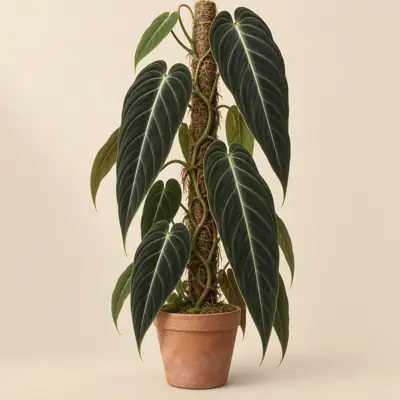
Watch: Monstera vs Philodendron vs Alocasia vs Anthurium
Overview
Philodendron melanochrysum is an evergreen climbing plant that can grow upward along supports or tree trunks.
Origin and habitat
Sources differ on its recorded native range in Colombia, with accounts principally placing it in Antioquia and Chocó. It occurs in moist Andean foothill environments in Colombia and is associated with tropical, humid conditions.
Characteristics
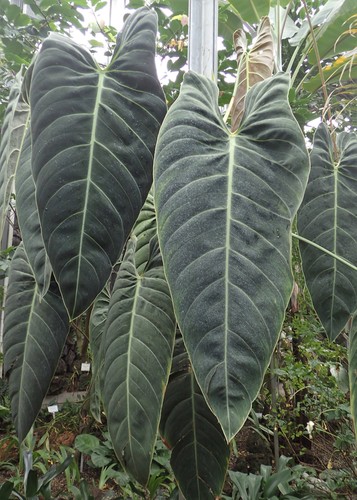
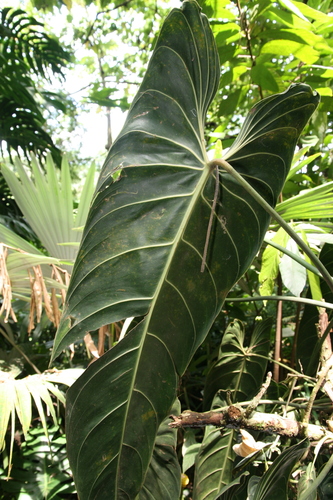
A single source reports a mature height of about 250–400 cm and a mature spread of about 50–100 cm; sources are few for these measurements. It is reported to grow slowly. The velvety leaves are mainly heart-shaped to elongated or heart-shaped-oblong; emerging leaves can have pink, salmon-red, ochre-yellow, copper-gold, or reddish-brown tones, becoming deep green to nearly black as they mature, with prominent, paler main and lateral veins, while sources describe substantial variation in leaf size. It is reported to produce a typical aroid spadix enclosed by a spathe, with unisexual flowers and sterile male flowers; in cultivation, the flowers are generally considered to have little ornamental value.
Light
It grows in bright indirect light to partial shade, while strong direct sunlight should be avoided.
Watering
Keep the growing medium slightly moist but well drained, watering again as it approaches dryness and reducing water in cooler conditions.
Humidity and airflow
It is reported to prefer high humidity, with the limited source reporting about 60% humidity.
Temperature and dormancy
A limited source reports a minimum temperature of about 15 °C. It is generally described as frost tender; keep above freezing.
Growing medium and mounting
Use a humus-rich, well-drained growing medium; RHS lists loam and indicates that the soil may be acidic, neutral, or alkaline. A single-source recommendation is for an airy mix.
Feeding
It is reported to benefit from feeding during vigorous growth.
Propagation
It can be propagated from soft tip cuttings or leaf-bud cuttings; genus-level information for Philodendron also records stem cuttings and layering.
Common problems
Scale insects and spider mites may occur, while genus-level information also lists slugs, mealybugs, aphids, and thrips. RHS describes the species as generally free of major disease, while genus-level Philodendron information records soft rot, leaf rot, root rot, and leaf spot. Overwatering may lead to root rot, and multiple sources repeatedly mention spider mites and scale insects as pest problems. It does not tolerate cold or cold drafts well, and a sheltered growing position is recommended.
Identification
Distinctive features include its climbing growth, elongated velvety dark mature leaves, and pale veins contrasting with the dark leaf surface; new leaves have warmer colors and gradually darken as they mature, while large mature leaves can show a subtle golden or copper sheen in the light.
Photos


Sources
- GBIF Backbone: Philodendron melanochrysum Linden & André — CC BY 4.0 · link
- Wikipedia (en): Philodendron melanochrysum — CC BY-SA 4.0 · link
- 維基百科:金叶喜林芋 — CC BY-SA 4.0 · link
- Wikipedia (de): Philodendron melanochrysum — CC BY-SA 4.0 · link
- Wikipedia (fr): Philodendron melanochrysum — CC BY-SA 4.0 · link
- Wikipedia (es): Philodendron melanochrysum — CC BY-SA 4.0 · link
- GBIF descriptions: Catálogo de Plantas y Líquenes de Colombia; CATE Araceae — per dataset · link
- RHS Plants: Philodendron melanochrysum — © RHS, facts only · link
- NHK みんなの趣味の園芸 植物図鑑: Philodendron (genus-level) — © NHK出版, facts only · link
- NC State Plant Toolbox: Philodendron (genus-level) — copyright (facts only) · link
- Shop Philodendron Melanochrysum M online | PLNTS.com (plnts.com) — facts only (§12) · link
- Philodendron melanochrysum | Foliage Factory (foliage-factory.com) — facts only (§12) · link
- Philodendron melanochrysum 'S' (www.araflora.com) — facts only (§12) · link