
vilevine (Philodendron hederaceum)
Philodendron hederaceum is a perennial evergreen climbing or trailing vine that can grow attached to tree trunks and may have a semi-epiphytic habit.
Watch: Monstera vs Philodendron vs Alocasia vs Anthurium
Overview
Philodendron hederaceum is a perennial evergreen climbing or trailing vine that can grow attached to tree trunks and may have a semi-epiphytic habit.
Origin and habitat
Sources differ in their descriptions of its native range, which includes Mexico, Central America, the Caribbean or West Indies, and tropical South America; Taiwan is not native range, and the species has become naturalized there after escaping from cultivation. Sources differ on habitat details; it occurs in evergreen forests and cloud forests, often as a semi-epiphytic vine climbing trees, across habitats from lowlands to higher elevations. It occurs in tropical forest environments and is usually grown as a greenhouse or indoor plant in temperate regions.
Characteristics
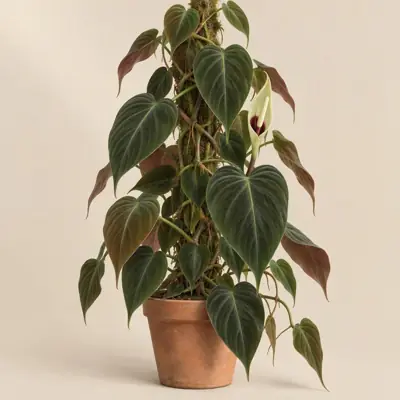
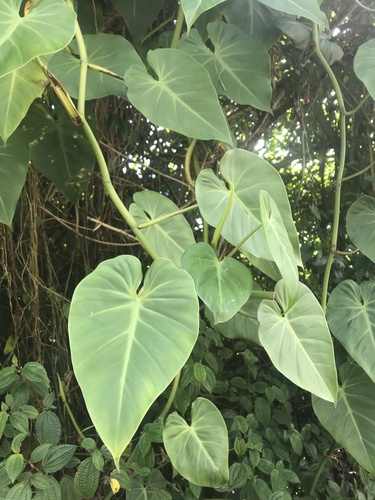
Sources differ, with the few available sources placing mature height at about 150–250 cm. It is reported to have a mature spread of about 50–100 cm, based on few sources. Sources differ in leaf descriptions: the alternate, simple leaves range from heart-shaped to broadly ovate with tapering tips, and mature leaves may become larger; their surfaces may be dark green and semi-glossy to nearly velvety, with some plants showing reddish-green or purple tones. Mature plants can form the typical aroid inflorescence, with a generally green to pale green spathe and a spadix that may be white; sources differ on fruit color, describing berries as greenish white in one account while another gives orange, red, or white for Philodendron fruit generally.
Light
Philodendron hederaceum does best in bright, indirect light to partial shade, tolerates low light, and should be kept out of strong direct sunlight.
Watering
Keep the growing medium slightly moist but well drained; during active growth, water thoroughly after the surface has dried slightly, avoid prolonged waterlogging, and reduce watering frequency in winter.
Humidity and airflow
It is reported to prefer moderate humidity.
Temperature and dormancy
Based on few sources, it is reported to require a minimum temperature of about 15 °C. It is generally assigned the H1A hardiness category.
Growing medium and mounting
It is reported to suit a moisture-retentive but well-drained growing medium; RHS recommends a loose, acidic, peat-free formulation that may contain volcanic rock or pumice, fine bark, leaf mould, or chopped sphagnum moss, with an acidic to neutral pH. It is reported to have aerial and soil roots and benefits from an airy mix.
Feeding
It is reported to benefit from liquid houseplant fertilizer during its active growing period, with feeding stopped when growth slows in winter and resumed in spring.
Propagation
Philodendron hederaceum can be propagated by stem-tip cuttings, leaf-bud cuttings, other stem cuttings, or layering; cuttings may be rooted in soil or water, and spring and summer are suitable for propagation.
Common problems
Potential pests include aphids, spider mites or greenhouse red spider mites, mealybugs, scale insects, and greenhouse thrips. Serious diseases are generally uncommon, but leaf spot can occur, while overly wet growing medium, overwatering, or standing water in the pot can lead to root rot. It is sensitive to low temperatures, requires indoor or greenhouse cultivation in temperate regions, and prefers a sheltered environment.
Identification
Philodendron hederaceum is commonly grown indoors as a climbing or trailing vine with heart-shaped leaves; its petioles lack grooves, prominent stipules are visible on new growth, and older stipules fall away, features that can help distinguish it from pothos-type plants.
Photos


Sources
- GBIF Backbone: Philodendron hederaceum (Jacq.) Schott — CC BY 4.0 · link
- Wikipedia (en): Philodendron hederaceum — CC BY-SA 4.0 · link
- Wikipedia (es): Philodendron hederaceum — CC BY-SA 4.0 · link
- GBIF descriptions: Catálogo de Plantas y Líquenes de Colombia; Plantas vasculares que se han reportado en los bosques s — per dataset · link
- NC State Plant Toolbox: Philodendron hederaceum — copyright (facts only) · link
- TaiCOL 臺灣物種名錄: Philodendron hederaceum — CC BY 4.0 · link
- RHS Plants: Philodendron hederaceum — © RHS, facts only · link
- USDA PLANTS Database: Philodendron hederaceum — Public domain (US Government work) · link
- NHK みんなの趣味の園芸 植物図鑑: Philodendron hederaceum — © NHK出版, facts only · link