
vilevine (Philodendron hederaceum)
Philodendron hederaceum is an evergreen, perennial, climbing or trailing hemiepiphytic vine that can climb tree trunks or grow as a hanging plant.
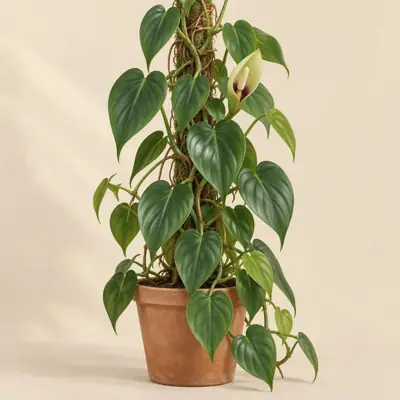
Watch: Monstera vs Philodendron vs Alocasia vs Anthurium
Overview
Philodendron hederaceum is an evergreen, perennial, climbing or trailing hemiepiphytic vine that can climb tree trunks or grow as a hanging plant.
Origin and habitat
Sources differ on the native range, describing it as extending across Mexico, Central America, the West Indies or Antilles, and tropical South America, including Brazil, Peru, and Bolivia. It is a hemiepiphytic forest vine that commonly climbs tree trunks and can also trail along the ground, climb rocks, or hang from branches. It occurs in a tropical climate and is mainly grown indoors, in greenhouses, or in warm glasshouses in temperate regions.
Characteristics
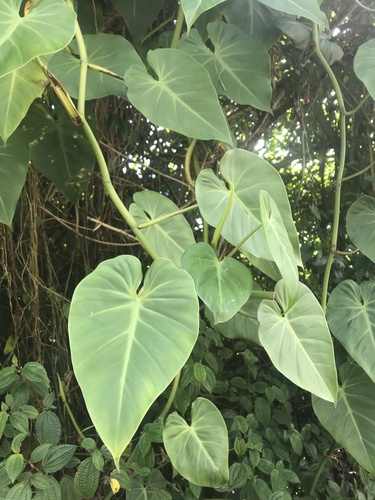
Sources differ, with the few available sources indicating a mature height of about 150–250 cm; the few available sources report a mature spread of about 50–100 cm. It is reported to grow rapidly; its alternate, simple mature leaves are broadly ovate to heart-shaped, with a deeply indented base, an acuminate tip, and usually dark green surfaces that may be glossy or slightly velvety. Mature plants can produce typical aroid inflorescences, usually with one in each leaf axil, with green to pale-green spathes and a white spadix, although inflorescences are uncommon; mature plants can also set fruit. In its natural range, it is reported to be capable of flowering and fruiting throughout the year.
Light
Philodendron hederaceum does well in bright, indirect light to partial shade, grows well in moderate light, and tolerates low light.
Watering
Keep the growing medium slightly moist but well drained; during active growth, allow the surface to dry slightly before watering thoroughly and avoid prolonged standing water in the container, while reducing watering frequency when growth slows in winter.
Humidity and airflow
It is generally reported to prefer moderate humidity.
Temperature and dormancy
Sources differ, with the few available sources indicating a minimum temperature of about 15 °C. It is generally reported as H1A and frost tender; keep above freezing.
Growing medium and mounting
Use a well-drained, moisture-retentive, organic-rich growing medium; an acidic, peat-free, airy and moisture-retentive mix may include volcanic rock or pumice, fine bark, leaf mould, or sustainably sourced sphagnum moss, and acidic to neutral conditions are suitable. Philodendron hederaceum has aerial and soil roots.
Feeding
It is reported to benefit from liquid houseplant fertilizer during the growing season, with feeding stopped in winter and resumed in spring.
Propagation
Propagation can use stem-tip cuttings, leaf-bud cuttings with an axillary bud, or layering; cutting material can root in soil or water, and propagation is suitable in spring and summer.
Common problems
Possible pests include aphids, spider mites, scale insects, mealybugs, and greenhouse thrips. Leaf spot and root rot can occur, with root rot associated with excessively wet growing medium; broader Philodendron cultivation information also records soft rot and leaf rot. Overwatering or standing water in the container can cause root rot, so cultivation should balance moisture with good drainage. It does not tolerate low temperatures and, in temperate regions, requires cultivation indoors, in a glasshouse, or in another protected environment.
Identification
It is generally reported as a common indoor vine with glossy, heart-shaped leaves; the petioles are entire and ungrooved, free stipules are visible on new growth, and older stipules are shed.
Photos


Sources
- GBIF Backbone: Philodendron hederaceum (Jacq.) Schott — CC BY 4.0 · link
- Wikipedia (en): Philodendron hederaceum — CC BY-SA 4.0 · link
- Wikipedia (es): Philodendron hederaceum — CC BY-SA 4.0 · link
- GBIF descriptions: Catálogo de Plantas y Líquenes de Colombia; Plantas vasculares que se han reportado en los bosques s — per dataset · link
- NC State Plant Toolbox: Philodendron hederaceum — copyright (facts only) · link
- RHS Plants: Philodendron hederaceum — © RHS, facts only · link
- USDA PLANTS Database: Philodendron hederaceum — Public domain (US Government work) · link
- NHK みんなの趣味の園芸 植物図鑑: Philodendron hederaceum — © NHK出版, facts only · link
- Buy Philodendron hederaceum 'Brasil' with Canarius (canarius.com) — facts only (§12) · link