
philodendron (Philodendron birkin)
Philodendron is reported to include diverse growth habits, including epiphytic and semi-epiphytic forms and a few terrestrial forms; horticulturally, the genus includes climbing and upright, self-supporting types, while ‘Birkin’ is upright, self-supporting, and non-vining. Philodendron is reported to be a herbaceous perennial.
Overview
Philodendron is reported to include diverse growth habits, including epiphytic and semi-epiphytic forms and a few terrestrial forms; horticulturally, the genus includes climbing and upright, self-supporting types, while ‘Birkin’ is upright, self-supporting, and non-vining. Philodendron is reported to be a herbaceous perennial.
Origin and habitat
Sources differ on the native range, describing primarily tropical parts of the Americas, tropical forests of Central and South America, or tropical to subtropical regions of the world. Philodendron is reported to inhabit tropical forests, often climbing tree trunks or growing as an epiphyte; it may also be semi-epiphytic, while a few kinds are terrestrial. It is reported to occur in warm tropical to subtropical environments.
Characteristics
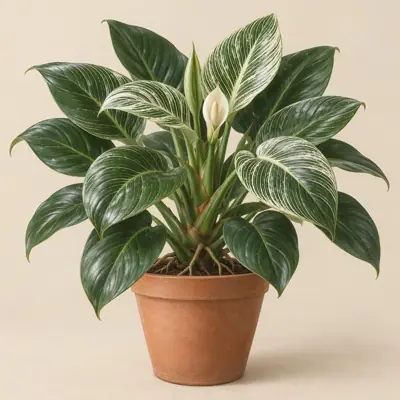
Sources differ on mature height, giving a range of about 10–1000 cm. A single source reports a mature spread of about 30.48–457.2 cm, so sources are few. Philodendron is generally described as capable of vigorous growth, while ‘Birkin’ is reported to grow more slowly; leaf form varies markedly by kind and maturity, and ‘Birkin’ has glossy dark-green leaves typically marked with fine cream-to-white stripes whose density varies among leaves. The inflorescence is reported to consist of a spathe and spadix; the usually waxy spathe may be bicolored, while the spadix has regions of female, fertile male, and sterile male flowers; fruits are berries that vary in maturation time and are generally whitish with some green, though orange or yellow fruits also occur.
Light
Philodendron is generally best in bright indirect light or filtered light and can accept medium light; strong direct sunlight should be avoided because it can scorch leaves, while in tropical outdoor conditions it may be placed in shade to partial shade.
Watering
During the growing period, it is generally watered thoroughly after the surface or upper growing medium begins to dry; the medium should remain moderately moist but well drained, avoiding standing water, overwatering, and prolonged complete drying, while in winter it can be allowed to dry somewhat more before watering.
Humidity and airflow
Philodendron generally prefers high humidity.
Temperature and dormancy
Philodendron is generally associated with warm conditions and is reported to be frost tender; keep above freezing. A single source reports its hardiness in a warm USDA zone range.
Growing medium and mounting
A fertile, well-drained medium rich in organic matter or humus is generally recommended; it should retain moderate moisture without becoming waterlogged. Philodendron is reported to have aerial and soil roots and to use a standard mix.
Feeding
Feeding is generally recommended during the growing period from spring through autumn, using slow-release or fast-acting liquid fertilizer; guidance for ‘Birkin’ also includes periodic feeding or following the label of an indoor-plant fertilizer product.
Propagation
Philodendron is reported to be propagated by stem cuttings or layering; for vining kinds, stem sections containing several nodes may be used, with cuttings kept in bright shade and the propagation medium kept from drying until rooting, followed by potting after establishment.
Common problems
Reported pests include scale insects, spider mites, thrips, mealybugs, aphids, and slugs. Reported disease problems include soft rot, leaf rot, root rot, and leaf spots. Common cultivation risks are reported to include overwatering, standing water, and leaf scorch from strong direct light; in very hot conditions, ‘Birkin’ may develop fewer white stripes. Philodendron is reported to be sensitive to cold and should be kept away from cold drafts, while ‘Birkin’ may slow or stop growing under cooler conditions.
Identification
‘Birkin’ is generally distinguished by fine white or cream stripes on glossy dark-green leaves and by a compact, upright, self-supporting, non-climbing habit; some leaves may develop red patches or revert toward reddish-green coloration.
Sources
- Wikipedia (en): Philodendron — CC BY-SA 4.0 · link
- NHK みんなの趣味の園芸 植物図鑑: Philodendron (genus-level) — © NHK出版, facts only · link
- NC State Plant Toolbox: Philodendron (genus-level) — copyright (facts only) · link
- Philodendron Birkin: Plant Care and Growing Guide (Birkin Plant Pictures) (leafyplace.com) — facts only (§12) · link
- Can You Use Potting Mix For Philodendron? - Houseplant Central (houseplantcentral.com) — facts only (§12) · link
- Philodendron Birkin Plant Care & Complete Growing Guide (getbusygardening.com) — facts only (§12) · link
- Philodendron Birkin (White wave or Birkin white) | 15-20cm – Acacia Garden Cente (acaciagardencenter.com) — facts only (§12) · link
- Birkin Philodendron – Costa Farms (www.costafarms.com) — facts only (§12) · link
- Birkin Philodendron | Plant Addicts (plantaddicts.com) — facts only (§12) · link
- Philodendron ‘Birkin’ | Foliage Factory (foliage-factory.com) — facts only (§12) · link
- Philodendron Birkin - Ball (ballaustralia.com) — facts only (§12) · link