
Philodendron billietiae (Philodendron billietiae)
Philodendron billietiae is a semi-epiphytic, appressed climbing plant that can grow attached to trees or rocks. It is reported to be evergreen.
Watch: Monstera vs Philodendron vs Alocasia vs Anthurium
Overview
Philodendron billietiae is a semi-epiphytic, appressed climbing plant that can grow attached to trees or rocks. It is reported to be evergreen.
Origin and habitat
Sources differ on its native range, describing northern Brazil's Pará, Guyana, and French Guiana. It inhabits low-elevation tropical moist rainforest, where it may climb attached to supports or grow on rocks. Its habitat has a warm, humid tropical rainforest climate.
Characteristics
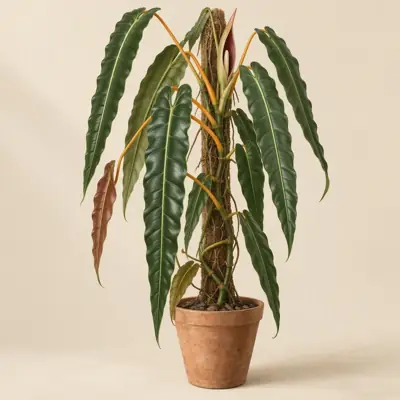
Mature plants reach 50–100 cm in height; with few sources available, mature spread is reported at about 10–50 cm. The leaves are mostly clustered near the stem tip and hang downward, with shapes ranging from narrowly triangular to narrowly ovate-triangular or elongated triangular; they are dark green above and paler beneath, often with slightly wavy margins, while young leaves are reddish. The upright inflorescences arise from leaf axils; the spathe is yellow-green to dark green outside, with white to greenish-white areas and purplish-red to chestnut coloration inside, and it surrounds a spadix. Under suitable conditions, it produces new leaves over the course of a year and takes several years to reach mature size.
Light
Philodendron billietiae grows in bright indirect light to partial shade and should be protected from strong direct sunlight.
Watering
During active growth, keep the growing medium moist but well drained, watering thoroughly after the surface dries slightly while avoiding standing water and prolonged root saturation; reduce watering frequency when growth slows in winter.
Humidity and airflow
It is generally reported to prefer high humidity.
Temperature and dormancy
With few sources available, the reported preferred temperature is about 20–25 °C, with a reported minimum of about 18 °C. It is frost tender; keep above freezing.
Growing medium and mounting
Use a well-drained medium that retains moderate moisture and may contain loam, sandy material, and organic matter; it can be loose, acidic to neutral, peat-free, and both moisture-retentive and free-draining. An airy mix is generally recommended.
Feeding
Sources differ on feeding details, but describe using liquid fertilizer during the growing season and stopping feeding in winter.
Propagation
Philodendron billietiae can be propagated from tip or stem-tip cuttings, or from stem sections or leaf-bud cuttings that include a mature leaf and node.
Common problems
It is reported to be susceptible to scale insects, greenhouse red spider mites, and mealybugs. It is generally described as having few disease problems, though genus-level information reports that overwatering may cause root rot and that leaf spots may occur. Waterlogged growing medium can cause root rot, while strong direct sunlight can scorch the leaves. It prefers warm conditions, should not be exposed to low temperatures, and should be kept in a sheltered position.
Identification
Its most conspicuous features are yellow to orange-yellow elongated petioles and narrow, elongated, drooping leaves with wavy margins.
Photos


Sources
- GBIF Backbone: Philodendron billietiae Croat — CC BY 4.0 · link
- Wikipedia (en): Philodendron billietiae — CC BY-SA 4.0 · link
- 維基百科:橘梗蔓綠絨 — CC BY-SA 4.0 · link
- Wikipedia (fr): Philodendron billietiae — CC BY-SA 4.0 · link
- GBIF descriptions: CATE Araceae — per dataset · link
- RHS Plants: Philodendron billietiae — © RHS, facts only · link
- NC State Plant Toolbox: Philodendron (genus-level) — copyright (facts only) · link