
Phalaenopsis hybrid (Phalaenopsis hybrid)
Phalaenopsis hybrida is reported to be a perennial, monopodial tropical herbaceous orchid that is mainly epiphytic, while some native species may grow on rocks.
Overview
Phalaenopsis hybrida is reported to be a perennial, monopodial tropical herbaceous orchid that is mainly epiphytic, while some native species may grow on rocks.
Origin and habitat
The reported native range of Phalaenopsis extends from India, southern China, and Indochina to Malaysia, Indonesia, the Philippines, and New Guinea, with species also occurring in Queensland, Australia; horticultural information also lists Taiwan. It is reported to grow mainly as an epiphyte on other plants, although some native species may grow on rocks, and to favor warm, humid conditions in tropical to subtropical Asia and warm areas including northeastern Australia.
Characteristics
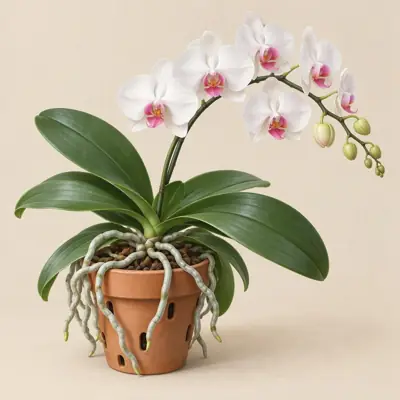
Sources differ on mature height, placing it at about 10–100 cm; sources are few for mature spread, reported at about 0–60.96 cm. Vegetative growth is reported to be faster under warm conditions, with seedlings potentially growing quickly enough to require regular repotting. The leaves are generally large, thick, and leathery, ranging from oblong-elliptic to elliptic and often arranged in rows, and they can store water and nutrients; the flowers are reported to be flat and relatively long-lasting, varying in size by species or cultivar and borne on upright to pendent, sometimes branching inflorescences, with horticultural colors including white, red, pink, yellow, purple, and multicolored forms. Flowering is reported to have no fixed period but to be more common from spring into summer, and flowers can remain in bloom for an extended period under good cultivation.
Light
Phalaenopsis hybrida is generally reported to prefer bright, indirect light to low light and to avoid strong direct sunlight; indoors, a location near an east-facing window is preferred, while south- or west-facing windows require appropriate shading. Sources are few, but a light level of about 12000–21500 is reported.
Watering
It is generally recommended to water thoroughly and then allow the medium to become nearly dry or slightly dry before watering again, without leaving the roots in standing water or persistently wet, soggy medium; water demand is higher in summer and lower in winter, and water should not remain in the crown for long. Sources are few, but winter watering is reported at about 10 days.
Humidity and airflow
Sources differ, but the reported humidity range is about 50–80 %. It is reported to prefer high humidity and generally needs moderate airflow.
Temperature and dormancy
Sources differ on specific temperature conditions, while specialist information generally describes Phalaenopsis hybrida as warm-growing and frost tender; keep above freezing.
Growing medium and mounting
It is generally grown in an airy, well-drained orchid medium such as bark, sphagnum moss, or coconut-husk material, while persistently wet, soggy conditions are avoided. It is reported to be epiphytic.
Feeding
During active growth, regular dilute feeding is generally recommended; balanced fertilizer may be used, while a higher-nitrogen fertilizer may also be used with bark media.
Propagation
It is reported not to propagate readily in quantity from side shoots; occasional side shoots may be divided after they have grown, or plantlets on flower stalks may be removed and planted after developing roots.
Common problems
Scale insects, thrips, mealybugs, slugs, and false spider mites are reported as possible pests. Reported problems include gray-mold spotting, crown or new-leaf rot, and root rot associated with excessive moisture; retained water in the crown can also favor rot under hot or cold conditions. Bud drop may follow sudden changes in temperature, humidity, water, feeding, or location, while persistently wet medium can promote root rot and water retained in the crown can lead to crown or new-leaf rot. It is generally described as having weak cold tolerance, greater heat tolerance, and sensitivity to strong sunlight; root rot is especially likely when temperatures are low and the medium is too wet, while warm cultivation calls for greater humidity and airflow.
Identification
Phalaenopsis hybrida generally lacks conspicuous pseudobulbs and is characterized vegetatively by a short leafy stem, thick elongated roots, and large fleshy leaves; its flowers are flat in form and long-lasting, with flower stalks emerging near the leaf bases.
Sources
- Wikipedia (en, genus): Phalaenopsis — CC BY-SA 4.0 · link
- AOS culture sheet: Phalaenopsis (genus-level) — © American Orchid Society, facts only · link
- NHK みんなの趣味の園芸 植物図鑑: Phalaenopsis (genus-level) — © NHK出版, facts only · link
- NC State Plant Toolbox: Phalaenopsis (genus-level) — copyright (facts only) · link