
Phalaenopsis equestris (Phalaenopsis equestris)
Phalaenopsis equestris is an epiphytic, monopodial tropical herbaceous orchid without pseudobulbs. It is an evergreen perennial.
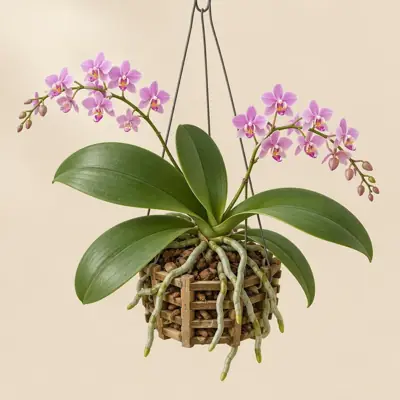
Overview
Phalaenopsis equestris is an epiphytic, monopodial tropical herbaceous orchid without pseudobulbs. It is an evergreen perennial.
Origin and habitat
Phalaenopsis equestris is native to Taiwan and the Philippines, with a native Taiwanese population explicitly recorded on Little Orchid Island. It is reported to grow as an epiphytic orchid in low-elevation forest below the canopy, avoiding direct sunlight and sometimes attaching to moss-covered tree trunks. Its environment is tropical, warm, and humid.
Characteristics
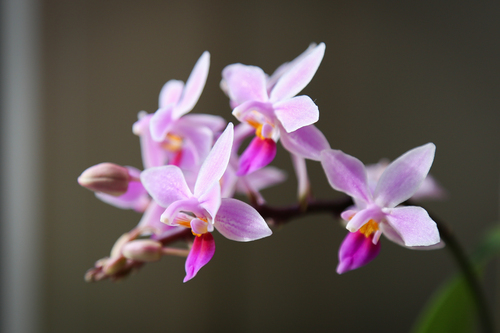
Sources differ, with the few available accounts placing mature height at about 10–50 cm and mature spread at about 10–50 cm. The thick, fleshy, green leaves are elliptical to ovate; new leaves continue to form at the tip of the monopodial stem, and the leaves also store water. The flowers are small, commonly pink to rose-purple, and highly variable in color; the inflorescences bear multiple flowers.
Light
Provide bright filtered light to partial shade and avoid direct midday sun. One source reports a light range of about 15000–20000, so available sources are few. It is classified for low light.
Watering
Water moderately in a well-draining medium, watering again as it approaches dryness and avoiding water collecting in the center of the crown; aerial roots may be misted periodically. The drying preference is to keep slightly dry.
Humidity and airflow
One source reports humidity of about 50–60 %, so available sources are few. It is generally reported to need moderate airflow.
Temperature and dormancy
The ideal temperature range is 17–25 °C. One source reports a minimum of about 14 °C and a maximum of about 35 °C, so available sources are few. It is warm-growing. It may be grown outdoors in containers or hanging baskets under the stated USDA hardiness classification, and it also has a stated RHS hardiness rating.
Growing medium and mounting
Use a loose, well-draining orchid medium based mainly on bark; it can also be grown attached to cork bark, while other recorded materials include pine bark, inorganic granules, charcoal, and polystyrene. It is epiphytic and prefers bark. It is reported to have aerial roots with velamen.
Feeding
During the growing season, orchid fertilizer is reported to be suitable for regular feeding.
Propagation
It is reported to be propagated from seed under controlled laboratory conditions; when mature plants form keikis, they may be separated after new roots have developed and planted in sphagnum moss.
Common problems
Potential pests include thrips, false spider mites, hemispherical scale, Boisduval scale, mealybugs, and aphids. Botrytis may occur, and water collecting in the center of the crown may increase the risk of bacterial rot. Strong direct light may scorch the leaves, and water collecting in the crown should be avoided. It prefers warm, humid, sheltered conditions and should be protected from strong direct midday sun.
Identification
Phalaenopsis equestris is a small epiphytic moth orchid without pseudobulbs, with thick, fleshy leaves and small pink to rose-purple flowers. Flower color and form vary markedly, including forms with white flowers or yellow lips.
Photos


Sources
- Wikipedia (en): Phalaenopsis equestris — CC BY-SA 4.0 · link
- 維基百科:桃紅蝴蝶蘭 — CC BY-SA 4.0 · link
- Wikipedia (fr): Phalaenopsis equestris — CC BY-SA 4.0 · link
- Wikipedia (es): Phalaenopsis equestris — CC BY-SA 4.0 · link
- NC State Plant Toolbox: Phalaenopsis equestris — copyright (facts only) · link
- Wikipedia (it): Phalaenopsis equestris — CC BY-SA 4.0 · link
- TaiCOL 臺灣物種名錄: Phalaenopsis equestris — CC BY 4.0 · link
- RHS Plants: Phalaenopsis equestris — © RHS, facts only · link
- Internet Orchid Species Photo Encyclopedia: Phalaenopsis equestris — © Jay Pfahl / IOSPE contributors, facts only · link
- AOS culture sheet: Phalaenopsis (genus-level) — © American Orchid Society, facts only · link
- NHK みんなの趣味の園芸 植物図鑑: Phalaenopsis (genus-level) — © NHK出版, facts only · link