
Phalaenopsis bellina (Phalaenopsis bellina)
Phalaenopsis bellina is a small, monopodial, mainly epiphytic orchid that commonly grows attached to tree trunks or branches. It is a perennial herbaceous plant.
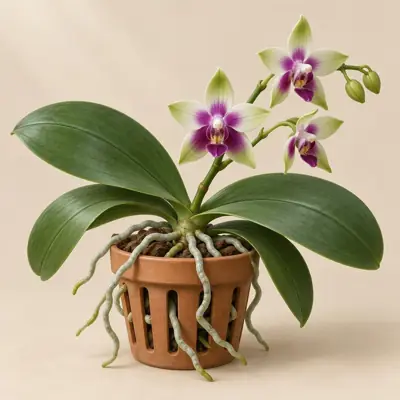
Overview
Phalaenopsis bellina is a small, monopodial, mainly epiphytic orchid that commonly grows attached to tree trunks or branches. It is a perennial herbaceous plant.
Origin and habitat
Sources differ on its native range, with Borneo described as its endemic range. It is an epiphyte of lowland tropical forest, occurring in humid, swampy, or riverside forest on trunks and branches, sometimes above streams. Its habitat is a warm, humid tropical lowland environment, with some habitats having distinct wet and dry cycles.
Characteristics
The leaves are thick, fleshy, and broad, ranging from elliptical to rounded, pale to medium green, and sometimes wavy. Sources differ in describing the flowers, which are strongly fragrant and nearly star-shaped, with sepals and petals ranging from nearly white or pale green to yellow-green and intense magenta, red-purple, or blue-purple coloration toward the center and base; the inner portions of the lateral sepals are usually more strongly colored. Sources differ on flowering time; flowering is mainly from late spring through autumn and may occur at other times under suitable conditions, while old inflorescences can flower again over multiple years. After pollination, it is reported to form pale green capsules, and large plants are reported to grow rapidly during the growing season.
Light
Sources differ on light guidance, but describe bright conditions while avoiding strong direct light, with shade or bright diffused light being suitable. A single source reports about 15000–20000 lux, so sources for this range are few. It is generally described as requiring medium light.
Watering
Sources differ on watering guidance: water moderately and thoroughly once the medium is nearly dry or slightly dry, without allowing it to remain completely dry for long, and avoid waterlogging that can cause root rot. A specialist single source reports watering about every 2 days in summer and about every 10 days in winter, so sources for these intervals are few. The drying preference is to keep slightly dry.
Humidity and airflow
A specialist single source reports about 50–80% humidity, so sources for this range are few. It is generally reported to prefer high humidity and need good airflow. Another single-source characterization generally says it needs moderate airflow.
Temperature and dormancy
It is warm-growing. A single source reports an ideal range of about 20–24 °C, so sources for this range are few. A single source reports a minimum of about 14 °C and a maximum of about 35 °C, so sources for these values are few.
Growing medium and mounting
It is epiphytic and has aerial roots with velamen, with bark as a media preference. A single source recommends a well-drained, loose, airy epiphytic-orchid medium and lists pine bark, tree-fern fiber, charcoal, polystyrene, or other airy materials.
Feeding
Fertilize regularly during the growing season; general Phalaenopsis cultivation information recommends beginning feeding in spring and applying liquid fertilizer periodically through early autumn.
Propagation
Phalaenopsis is reported to produce side shoots infrequently; when a side shoot or an offshoot on the flower spike forms, it can be separated and planted after it has grown and developed roots.
Common problems
Pests reported in Phalaenopsis cultivation include scale insects, thrips, slugs, and false spider mites, while problems can also include gray mold and rot of the crown or new leaves. Persistently wet medium can cause root rot, water collecting in the crown can cause new-leaf or crown rot, and salt buildup from hard water or water with high total dissolved solids can damage roots. It prefers warmth and has low cold tolerance; hot conditions require higher humidity and good airflow, while strong direct sunlight should be avoided.
Identification
Phalaenopsis bellina is distinguished by broad, thick leaves and strongly fragrant flowers with an intensely purple-red center; compared with the similar Phalaenopsis violacea, its petals are reported to be generally broader and its fragrance composition distinctly different.
Photos


Sources
- Wikipedia (en): Phalaenopsis bellina — CC BY-SA 4.0 · link
- Wikipedia (de): Phalaenopsis bellina — CC BY-SA 4.0 · link
- Wikipedia (fr): Phalaenopsis bellina — CC BY-SA 4.0 · link
- Wikipedia (es): Phalaenopsis bellina — CC BY-SA 4.0 · link
- Wikipedia (it): Phalaenopsis bellina — CC BY-SA 4.0 · link
- Internet Orchid Species Photo Encyclopedia: Phalaenopsis bellina — © Jay Pfahl / IOSPE contributors, facts only · link
- AOS culture sheet: Phalaenopsis (genus-level) — © American Orchid Society, facts only · link
- NHK みんなの趣味の園芸 植物図鑑: Phalaenopsis bellina — © NHK出版, facts only · link
- NC State Plant Toolbox: Phalaenopsis (genus-level) — copyright (facts only) · link