
perilla (Perilla frutescens)
Perilla frutescens is an upright herb that can branch freely. Sources differ in describing its life cycle, including its classification as an annual herb.
Overview
Perilla frutescens is an upright herb that can branch freely. Sources differ in describing its life cycle, including its classification as an annual herb.
Origin and habitat
It is native to Asia, with accounts broadly pointing to East Asia, South Asia, Southeast Asia, and the Indian subcontinent, although sources differ on a more precise center of origin. It occurs in wastelands, fallow land, fields, roadsides, riverbanks or gravelly riverbeds, and around homes, and it is also widely cultivated; some sources record it in hills and mountainous environments. It prefers warm conditions and can be grown as an annual crop from warm-temperate to tropical climates.
Characteristics
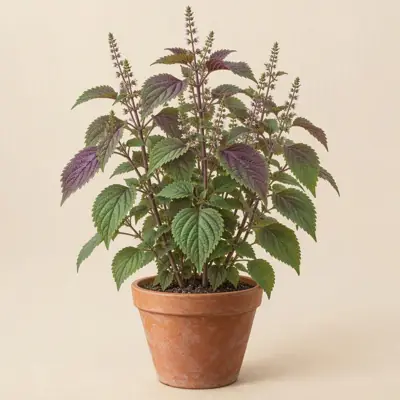
Sources differ on mature height, placing it at about 30–200 cm, while few sources report a mature spread of about 0–45.72 cm. It grows rapidly and has opposite, serrated leaves ranging from round and ovate to broadly ovate or elliptic, with pointed tips; leaves may be green or purple, some have purplish-red undersides, and they have a distinctive aroma. Sources differ in descriptions of its small flowers, which occur in raceme-like or whorled clusters and may be white, purple, or pink; flowering occurs from summer into autumn. It is reported to produce small, net-patterned segmented fruits, with mature fruits or seeds appearing nearly spherical and ranging in color from white and gray to brown and dark brown.
Light
It grows in full sun to partial sun and does better with ample light; excessive shade may result in weak growth and sparse leaves.
Watering
Sources differ on watering details, but describe keeping the growing medium moist yet well drained during growth while avoiding prolonged dryness or waterlogging; watering may be done when the surface dries or the leaves become slightly wilted.
Temperature and dormancy
Few sources place the minimum temperature at about -1.1 °C and the ideal temperature at about 20–30 °C. Sources differ on its USDA hardiness classification. It is reported to tolerate brief light frost.
Growing medium and mounting
Sources differ on growing-medium details, but generally favor well-drained soil that retains moderate moisture; light, organic-rich, or fertile soils are also mentioned, and recommendations for soil acidity and alkalinity differ.
Feeding
Sources differ on fertilizer needs: some recommend feeding during the growing period or at intervals, while other cultivation information indicates that additional feeding is unnecessary during growth.
Propagation
It can be propagated by seed, and the seeds may self-sow; seedlings can be planted out after they have developed several true leaves.
Common problems
It is reported that larvae of a moth pest may feed on the leaves. It can self-sow heavily and spread rapidly, and in parts of North America it is considered invasive or a noxious weed; insufficient light may cause sparse leaves and weak growth. It does not tolerate severe cold, and young plants should be protected from low temperatures; some sources also describe poor drought tolerance, while strong winds, typhoons, or heavy rain may damage tall, weak plants.
Identification
Sources differ in their descriptions, but identifying features include hairy, four-angled stems, opposite serrated leaves, and a strong distinctive aroma from the plant or leaves; both green-leaved and purple-leaved forms occur.
Photos


Sources
- GBIF Backbone: Perilla frutescens (L.) Britton — CC BY 4.0 · link
- Wikipedia (en): Perilla frutescens — CC BY-SA 4.0 · link
- 維基百科:紫蘇 — CC BY-SA 4.0 · link
- Wikipedia (ja): エゴマ — CC BY-SA 4.0 · link
- Wikipedia (de): Perilla — CC BY-SA 4.0 · link
- Wikipedia (es): Perilla frutescens — CC BY-SA 4.0 · link
- GBIF descriptions: Manual of the Alien Plants of Belgium; Checklist of introduced taxa in Cyprus; Database of Vascular — per dataset · link
- NC State Plant Toolbox: Perilla frutescens — copyright (facts only) · link
- Wikipedia (it): Perilla frutescens — CC BY-SA 4.0 · link
- Wikipedia (nl): Perilla frutescens — CC BY-SA 4.0 · link
- Wikipedia (ko): 들깨 — CC BY-SA 4.0 · link
- TaiCOL 臺灣物種名錄: Perilla frutescens — CC BY 4.0 · link
- 農業知識入口網 植物圖鑑: Perilla frutescens — © MOA, facts only · link
- Useful Tropical/Temperate Plants: Perilla frutescens — CC BY-NC-SA 3.0 (facts only) · link