
String of Turtles (Peperomia prostrata)
Peperomia prostrata is reported to be a delicate trailing herb with pendent, creeping, outward-spreading stems suited to hanging containers. It is reported to be an evergreen perennial.
Overview
Peperomia prostrata is reported to be a delicate trailing herb with pendent, creeping, outward-spreading stems suited to hanging containers. It is reported to be an evergreen perennial.
Origin and habitat
Peperomia prostrata is native to Ecuador. It is reported from humid tropical regions of Ecuador, with a humid tropical climate.
Characteristics
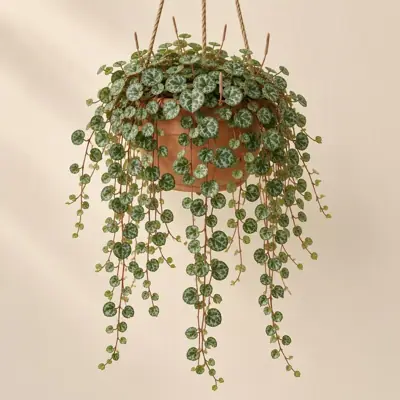
Based on few sources, mature height is reported at about 22.86–30.48 cm and mature spread at about 7.62–10.16 cm. Growth is reported to be slow. The leaves are reported to be small, simple, alternate, round to nearly round, fleshy, entire, and hairless; they are predominantly green with dark green marbling, sometimes with white or silver markings, while young leaves may show multicolored patterns and mature leaves are usually patterned in lighter and darker greens. The inflorescences are reported to be small, upright, brown to copper-brown, tail-like spikes, and plants grown indoors rarely flower.
Light
Bright, indirect light is reported to be preferred, though Peperomia prostrata can tolerate low light, where leaf color becomes less vivid; filtered canopy light and partial shade are also reported.
Watering
The growing medium is reported to do best when kept evenly moist and well drained while avoiding overwatering, as standing water or excessive moisture may cause root rot.
Temperature and dormancy
A hardiness-zone range is reported for Peperomia prostrata.
Growing medium and mounting
Loamy or sandy growing media are reported to be suitable when well drained and kept moist, with conditions ranging from acidic to neutral.
Propagation
Peperomia prostrata is reported to be propagated by leaf cuttings.
Common problems
Peperomia prostrata is reported to be generally resistant to pests, though mealybugs, spider mites, aphids, scale insects, and whiteflies should still be watched for. It is reported to be generally resistant to disease, while overwatering may lead to root rot. Low light is reported to make leaf color and markings less vivid. It is reported to prefer a consistently warm environment and should be protected from direct cold drafts.
Identification
The main distinguishing features are reported to be small round leaves with marbled patterns resembling miniature turtle shells, arranged along delicate red trailing stems.
Photos

