
Peperomia polybotrya (Peperomia polybotrya)
Peperomia polybotrya is a small, evergreen, perennial herb with a compact upright to clumping habit and can have a small tree-like appearance.
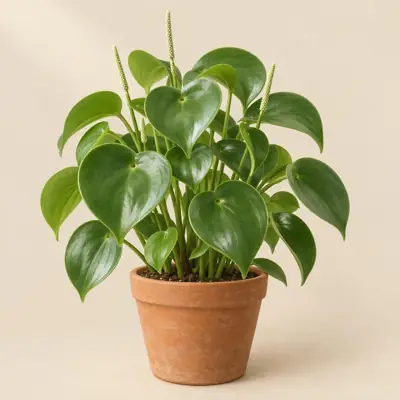
Overview
Peperomia polybotrya is a small, evergreen, perennial herb with a compact upright to clumping habit and can have a small tree-like appearance.
Origin and habitat
It is native to South America, from Colombia through Ecuador to Peru. It is reported from the Andes in a tropical, warm, humid climate.
Characteristics
Sources differ on mature size, placing height at about 30–40 cm and spread at about 30–30.5 cm. The thick, succulent leaves are glossy bright green and teardrop-shaped; they are peltate, with the petiole attached to the underside rather than the leaf margin, which can create a slight depression on the leaf surface. The flowers are very small and greenish white, borne on slender spikes. It is reported to flower in summer and to flower less often when grown indoors in pots.
Light
Sources differ on light guidance, describing bright indirect light to partial sun as suitable, with increased light in winter.
Watering
During the growing period, keep the medium moist but well drained and water moderately; reduce watering in winter and avoid overwatering.
Humidity and airflow
It is reported to prefer high humidity.
Temperature and dormancy
Sources differ in their descriptions of its hardiness. It is generally frost tender; keep above freezing.
Growing medium and mounting
Use a moist but well-drained medium; loam or sandy soil may be used, with acidic, neutral, or alkaline conditions, while indoor plants can be grown in houseplant potting mix.
Feeding
It is reported to be fed with a balanced liquid fertilizer monthly from spring through summer.
Propagation
It is reported to be propagated from stem cuttings in spring and summer, while mature seed can also be sown.
Common problems
Sources differ on pest concerns: spider mites, mealybugs, fungus gnats, and scale insects are listed as pests to watch for, while RHS describes the plant as generally having few pest problems. Sources differ on disease concerns: overwatering may cause root rot and prolonged wetness on the leaves may increase leaf-spot problems, while RHS describes the plant as generally having few disease problems. It is reported that common problems include root rot associated with overwatering and leaf spot associated with wet foliage. It is frost sensitive and should be kept from freezing conditions; warmer, protected positions are suitable.
Identification
Key identifying features are the thick, glossy, teardrop-shaped peltate leaves, the depression on the leaf surface created by the petiole attaching underneath, and the slender, spike-like inflorescences.
Photos


Sources
- Wikipedia (en): Peperomia polybotrya — CC BY-SA 4.0 · link
- Wikipedia (fr): Peperomia polybotrya — CC BY-SA 4.0 · link
- GBIF descriptions: Catálogo de Plantas y Líquenes de Colombia — per dataset · link
- NC State Plant Toolbox: Peperomia polybotrya — copyright (facts only) · link
- RHS Plants: Peperomia polybotrya — © RHS, facts only · link
- Top Tropicals catalog: Peperomia polybotrya — © Top Tropicals LLC (facts only) · link