
Egyptian starcluster (Pentas lanceolata)
Sources describe Pentas lanceolata somewhat differently as a tropical evergreen perennial herb to subshrub with a woody base, also commonly grown horticulturally as an annual flowering plant. It is a perennial that can be grown as such in warm regions, while in colder regions it is often grown as an annual flowering plant or an indoor plant.
Overview
Sources describe Pentas lanceolata somewhat differently as a tropical evergreen perennial herb to subshrub with a woody base, also commonly grown horticulturally as an annual flowering plant. It is a perennial that can be grown as such in warm regions, while in colder regions it is often grown as an annual flowering plant or an indoor plant.
Origin and habitat
Pentas lanceolata is native to tropical Africa, including East Africa and parts of central-eastern Africa, with its native range extending to Yemen and Saudi Arabia on the Arabian Peninsula. It is associated with tropical, warm climates and tolerates heat but not cold; in temperate climates it is usually grown as an annual or in containers, or moved indoors for overwintering.
Characteristics
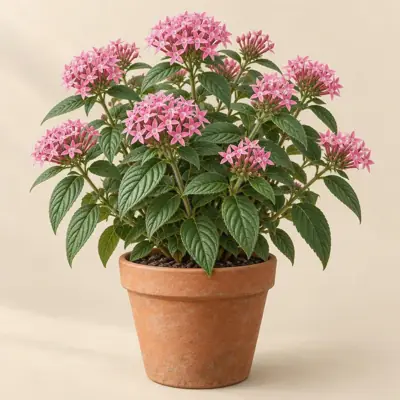
Sources differ on mature height, reporting a range of about 30–250 cm, while mature spread is 50–100 cm. It is reported to grow quickly, with young plants developing into clumping plants within an initial growing period. The green to dark green leaves are lance-shaped to ovate, hairy and prominently veined, sometimes glossy, and usually opposite but sometimes arranged in whorls. Dense, dome-shaped cymes form at branch tips, bearing small tubular, star-shaped flowers in red, pink, deep pink, white, purple, lavender, or sometimes bicolored forms; flowering is mainly from spring through autumn and can be prolonged or continuous under warm conditions with suitable light.
Light
Sources differ somewhat, but full sun is preferred, while partial sun or partial shade can also be tolerated; insufficient light can cause elongated growth and reduced flowering.
Watering
Water regularly during active growth while keeping the growing medium well drained; the surface can be allowed to dry slightly before watering again, and prolonged excessive moisture should be avoided.
Humidity and airflow
Pentas lanceolata is reported to prefer high humidity and needs good airflow.
Temperature and dormancy
Sources are few and differ on minimum temperature, with about 7 °C reported. It is associated with USDA hardiness zones in the warm range and is frost tender; keep above freezing.
Growing medium and mounting
Grow in well-drained, organic-rich soil; sandy loam or loam can be used, and it can adapt to acidic, neutral, or alkaline conditions.
Feeding
It is reported to benefit from regular flower fertilizer during flowering, followed by removal of spent flowers and additional feeding to encourage new shoots and subsequent flowering.
Propagation
It can be propagated by seed or cuttings; seeds can be started indoors, while tip or soft-shoot material can be used for cuttings, with Taiwanese sources recommending propagation by cuttings in spring or autumn.
Common problems
Possible pests include aphids, spider mites or other leaf mites, scale insects, and caterpillars that may feed on the leaves. Sources describe disease problems differently: poor airflow combined with excessive humidity may be associated with grey mould or damping-off, while another account describes the plant as generally having few disease problems. Insufficient sunlight can cause elongated growth and poor flowering, while excessive moisture or poor airflow can increase disease risk, and dense branching may be associated with scale insects. It is sensitive to cold and frost; in cold regions it needs to be moved indoors or grown as an annual.
Identification
Pentas lanceolata can be recognized by terminal flower clusters composed of many small tubular, star-shaped flowers, together with fine hairs on the plant and leaves and deep, conspicuous leaf veins.
Photos


Sources
- Wikipedia (en): Pentas lanceolata — CC BY-SA 4.0 · link
- 維基百科:五星花 — CC BY-SA 4.0 · link
- Wikipedia (ja): ペンタス — CC BY-SA 4.0 · link
- Wikipedia (fr): Pentas lanceolata — CC BY-SA 4.0 · link
- GBIF descriptions: Lista de especies de plantas exóticas y trasplantadas de Colombia; Catálogo de Plantas y Líquenes de — per dataset · link
- NC State Plant Toolbox: Pentas lanceolata — copyright (facts only) · link
- Wikipedia (pt): Pentas lanceolata — CC BY-SA 4.0 · link
- TaiCOL 臺灣物種名錄: Pentas lanceolata — CC BY 4.0 · link
- 農業知識入口網 植物圖鑑: Pentas lanceolata — © MOA, facts only · link
- RHS Plants: Pentas lanceolata — © RHS, facts only · link
- USDA PLANTS Database: Pentas lanceolata — Public domain (US Government work) · link
- Top Tropicals catalog: Pentas lanceolata — © Top Tropicals LLC (facts only) · link