
Zonal geranium (Pelargonium × hortorum)
Pelargonium hortorum is a perennial herb that can form a rounded clump; older stems may become partly woody and may be upright or somewhat trailing or vining. It is a frost-tender perennial and is also commonly grown as a seasonal annual or as an indoor potted plant.
Overview
Pelargonium hortorum is a perennial herb that can form a rounded clump; older stems may become partly woody and may be upright or somewhat trailing or vining. It is a frost-tender perennial and is also commonly grown as a seasonal annual or as an indoor potted plant.
Origin and habitat
Pelargonium hortorum is associated with South Africa, and both of its parents, Pelargonium zonale and Pelargonium inquinans, are associated with the Cape region of South Africa. It is a frost-tender perennial of warmer climates that can continue growing and flowering during warm periods; in colder regions it is often grown as an annual or brought indoors to overwinter.
Characteristics
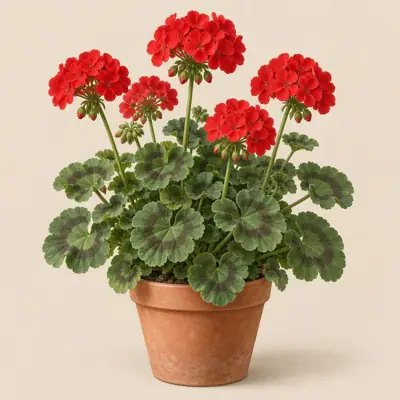
A single source reports a mature height of about 30.48–91.44 cm; sources are few for this range. The leaves range from roughly round to kidney-shaped, with some sources describing them as fan-shaped; they have palmately spreading veins and margins, and typical cultivars often show a dark or brown ring-shaped band and scented foliage. Sources differ in their descriptions of the flowers: they are borne on elongated, fairly upright stalks in dense, nearly umbel-like or globular clusters, may be single, semi-double, or double, and occur in red, pink, white, orange, yellow, and, according to agricultural information, blue cultivars. Sources differ on flowering season: flowering is prolonged but varies with climate and growing conditions, with combined accounts extending from spring until frost in autumn, while Taiwan information describes the cool seasons of winter and spring as the main flowering period.
Light
It is generally reported to prefer full sun; insufficient light can cause elongated growth and reduced flowering, while plants overwintered indoors are best placed in a bright location.
Watering
The growing medium should drain well; established plants have some drought tolerance, although moderate moisture can support stronger growth and flowering. For potted plants, watering can wait until the medium has dried, and watering should be greatly reduced during dormant overwintering.
Temperature and dormancy
It is generally reported to overwinter across a range of USDA hardiness zones, with another account suggesting overwintering may also be possible in colder zones.
Growing medium and mounting
It requires a well-drained growing medium, and agricultural information notes that acidic soil should be avoided; a sandy medium can be used for seed propagation.
Feeding
Fertilizer is generally reported to be applicable regularly during active cultivation and growth.
Propagation
It can be propagated from seed or stem cuttings, with cuttings described as the easier method. Agricultural information recommends propagation in spring or autumn, particularly autumn, using healthy shoots for cuttings; rooting occurs after a period of time, with another source also reporting rooting under good conditions.
Common problems
It is generally reported to be susceptible to pests including caterpillars, spider mites, mealybugs, scale insects, and thrips. It is generally reported to be susceptible to fungal and bacterial diseases, including southern bacterial wilt, bacterial leaf spot, and gray mold. Insufficient light can cause elongated growth and poor flowering, poor ventilation may increase the risk of foliar disease, and retaining bracts on cuttings may cause rot. It is frost-tender and should be protected from frost; during hot, humid periods, pruning and ventilation require attention.
Identification
Typical identifying features are dark ring-shaped bands on nearly round or kidney-shaped leaves and dense globular or nearly umbel-like flower clusters held above the foliage on long flower stalks.