
Parodia leninghausii (Parodia leninghausii)
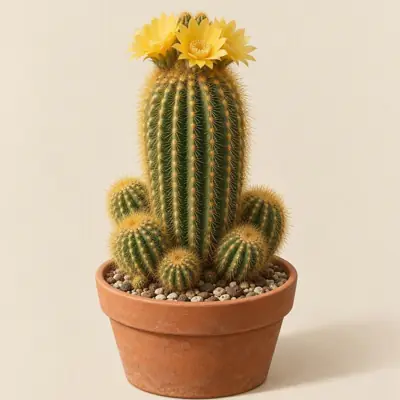
Parodia leninghausii is nearly spherical when young, later becoming upright and columnar; mature old plants may branch from the base to form clumps.
Overview
Parodia leninghausii is nearly spherical when young, later becoming upright and columnar; mature old plants may branch from the base to form clumps.
Origin and habitat
It is native to southern Brazil in Rio Grande do Sul, with more precise accounts placing it in the northeastern part of the state. It occurs in hilly grassland, rocky outcrops, cliffs and rock crevices, and can also grow shaded by larger plants in pine forest; the soil is well drained. Its native climate has warm and cool seasons, with winter nights that can approach freezing or bring light frost; precipitation occurs throughout the year, although conditions can be quite dry during cold winter weather.
Characteristics
Sources differ on mature height, placing it at about 60–100 cm. A single source reports a mature spread of about 10–50 cm, so sources are few. Sources differ in their descriptions of the flowers: they occur near the top of the plant, are yellow to lemon-yellow and bowl-shaped or silky in appearance, and usually appear only after the plant matures. Flowering occurs from spring through summer, with some accounts extending it into late summer, and flowering may occur more than once in a year.
Light
It takes full sun and prefers full sun or bright light; ample sunlight favors flowering, but the strongest direct summer sun should be avoided to reduce the risk of sunburn.
Watering
Water regularly to moderately during the growing season while ensuring that the medium drains quickly and does not remain waterlogged; keep it almost completely dry in winter, gradually increasing water after growth resumes in spring and reducing it as autumn begins.
Humidity and airflow
It is reported to need good airflow.
Temperature and dormancy
Sources differ on minimum-temperature figures, with a minimum reported at about -4 °C, while a single specialist source reports a maximum of about 30 °C, so sources for the latter are few. Sources differ on its hardiness-zone classification. It tolerates brief light frost and rests cool and dry in winter. A cold minimum of -4 °C is given.
Growing medium and mounting
Use a well-drained, well-aerated cactus medium; sandy, loamy or mineral-rich mixes are suitable, and RHS indicates that acidic to neutral media are suitable. It needs a fast-draining mix.
Feeding
Feeding may not be necessary in fresh medium; when needed, use a low-nitrogen liquid fertilizer in summer or during the growing season, and stop feeding after September.
Propagation
It can be propagated from seed, and some sources also report propagation by cuttings; RHS recommends sowing in spring or summer. Cuttings are a propagation method.
Common problems
Mealybugs and aphids may attack Parodia leninghausii, while information for the genus Parodia also lists spider mites and whiteflies. RHS indicates that disease is generally uncommon, although poor drainage or excessive watering may lead to root rot or fungal infection. Waterlogged medium or cold, wet conditions can cause root problems; insufficient light may produce overly weak growth and make flowering less likely, while intense summer sun can cause sunburn. It tolerates some cold, but sources differ on frost tolerance; keeping it dry is particularly important in cold conditions, and the strongest summer sun may cause sunburn.
Identification
The stem has numerous ribs densely covered with slender, soft or bristle-like golden-yellow to golden-brown spines; young plants are nearly spherical before elongating into a columnar form, and old plants often form clumps from the base.
Sources
- Wikipedia (en): Parodia leninghausii — CC BY-SA 4.0 · link
- LLIFLE Encyclopedia of living forms: Parodia leninghausii — CC BY-SA · link
- RHS Plants: Parodia leninghausii — © RHS, facts only · link
- 臺北典藏植物園 植物資料庫: Parodia leninghausii — © 臺北典藏植物園, facts only · link
- NC State Plant Toolbox: Parodia (genus-level) — copyright (facts only) · link
- Top Tropicals catalog: Parodia leninghausii — © Top Tropicals LLC (facts only) · link
- Parodia leninghausii - Golden Ball Cactus | MCG™ (mountaincrestgardens.com) — facts only (§12) · link
- PUKUBOOK: Parodia leninghausii — CC BY-NC (facts only) · link