
Pachypodium succulentum (Pachypodium succulentum)
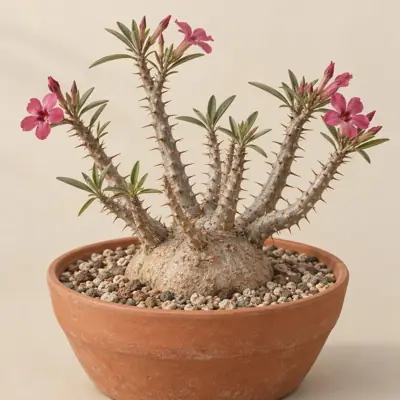
Pachypodium succulentum is a perennial succulent shrub with a large, mostly underground swollen rootstock and multiple slender, spiny branches arising from the base.
Overview
Pachypodium succulentum is a perennial succulent shrub with a large, mostly underground swollen rootstock and multiple slender, spiny branches arising from the base.
Origin and habitat
Pachypodium succulentum is endemic to South Africa, occurring in the Cape region and western Free State, with sources also specifically mentioning the Little Karoo and Eastern Cape. It inhabits arid, rocky grassland and dry scrub, often among rocks, and much of its swollen rootstock may remain underground. It is adapted to hot, dry conditions and prolonged drought; its water-storing stem and underground rootstock help it endure periods of water shortage, and it has some cold tolerance under dry conditions.
Characteristics
Mature plants reach 60–200 cm in height and grow slowly to very slowly. The narrow, linear to oblong-linear green leaves are hairy above, paler and densely hairy beneath, and are borne mainly on the upper parts of slender branches or in clusters along them. The flowers have a long tube with spreading lobes and range from white and pale pink to pink and dark red, usually with a darker longitudinal midline; flowering is also described as occurring from spring to early summer. The fruit consists of slender, tapering follicles with ovoid seeds bearing a white terminal tuft, and the plant has a swollen stem.
Light
Pachypodium succulentum grows in full sun to bright, light shade, and cultivation generally calls for ample sunlight and good ventilation.
Watering
During active growth, water and then allow the growing medium to dry before watering again; during winter dormancy, keep it nearly dry, especially in cool conditions. It tolerates prolonged drought, and a single source generally recommends watering when the mix has dried while the plant is in leaf. A single specialist source reports that water should be withheld while the plant is leafless.
Humidity and airflow
A single source reports that Pachypodium succulentum prefers low humidity and needs good airflow.
Temperature and dormancy
Sources differ on the lower temperature limit, with one source placing it at about -10 °C; another specialist source gives about 4 °C, so temperature figures are based on few sources. Sources also differ on its hardiness-zone classification, while specialist sources describe it as frost hardy and indicate that dormancy varies. A single specialist source reports that it has high heat tolerance.
Growing medium and mounting
Pachypodium succulentum needs a very fast-draining growing medium and should not be left in waterlogged conditions. Genus-level guidance suggests a mix containing small-grained akadama, small-grained kanuma, small pumice, and leaf mold.
Feeding
A single source reports that fertilizer may be applied during spring and autumn growth, using either slow-release chemical fertilizer or liquid fertilizer diluted according to its label.
Propagation
Pachypodium succulentum can be propagated by seed, cuttings, root cuttings, or stem cuttings. Root cuttings readily form roots and can regenerate shoots, leaves, and a swollen rootstock, while stem cuttings are comparatively more difficult.
Common problems
Excessively wet growing medium during winter or cold conditions can readily lead to rot, and poor drainage and waterlogging are major cultivation risks. Sources differ on cold sensitivity: tolerance depends strongly on moisture conditions, with some subfreezing cold tolerated when dry, while cultivation sources generally advise protection from freezing and note that cold, wet conditions can promote rot. A single source reports that aphids may occur, particularly during flowering. Excess moisture may cause soft rot or other rotting problems, and root wounds caused during repotting may provide an entry point for pathogens.
Identification
Pachypodium succulentum is distinguished by a large, turnip-shaped, water-storing rootstock that is mostly partly buried, with multiple slender, spiny branches arising from it. Its narrow leaves and white to dark red flowers with a darker midline are also characteristic.
Photos


Sources
- Wikipedia (en): Pachypodium succulentum — CC BY-SA 4.0 · link
- Wikipedia (de): Pachypodium succulentum — CC BY-SA 4.0 · link
- Wikipedia (es): Pachypodium succulentum — CC BY-SA 4.0 · link
- LLIFLE Encyclopedia of living forms: Pachypodium succulentum — CC BY-SA · link
- Desert-Tropicals: Pachypodium succulentum — © Philippe Faucon (desert-tropicals.com), facts only · link
- The Succulent Plant Page: Pachypodium (genus-level) — © R.J. Hodgkiss, facts only · link
- NHK みんなの趣味の園芸 植物図鑑: Pachypodium (genus-level) — © NHK出版, facts only · link
- Top Tropicals catalog: Pachypodium succulentum — © Top Tropicals LLC (facts only) · link
- Pachypodium succulentum | Giromagi cactus and succulents for sale | Buy plants o (www.giromagi.com) — facts only (§12) · link
- PUKUBOOK: Pachypodium succulentum — CC BY-NC (facts only) · link