
Kudu Lily (Pachypodium saundersii)
Pachypodium saundersii is a perennial, deciduous, succulent shrub with a swollen, tuberous or caudiciform form.
Overview
Pachypodium saundersii is a perennial, deciduous, succulent shrub with a swollen, tuberous or caudiciform form.
Origin and habitat
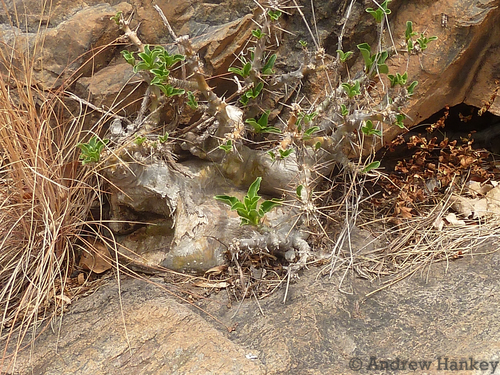
Sources differ on its native range, describing southern Africa, including Zimbabwe, Mozambique, Eswatini and South Africa, with records in Limpopo, Mpumalanga and KwaZulu-Natal and a distribution involving the Lebombo Mountains and adjacent lowlands. It occurs in lowland open woodland and dry scrub, often in sunny, rocky open woodland, rock crevices or exposed rock surfaces, including around the Lebombo Mountains. Its growth pattern is associated with warm, seasonally dry conditions, with growth during summer or warm periods and deciduous dormancy during the colder winter.
Characteristics
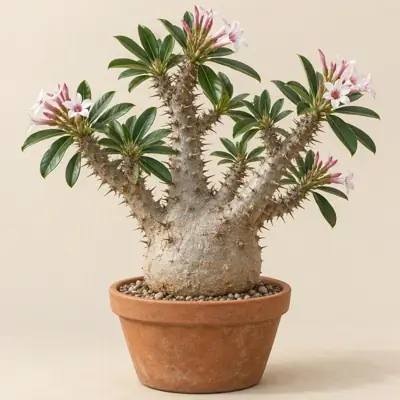
Mature plants reach 100–200 cm in height; the few sources for spread report about 100–200 cm. Sources differ on growth rate: it is described as slow-growing overall, but as relatively easier and faster-growing than other South African Pachypodium. The plant has a tuber; its green to dark-green leaves are hairless or nearly so, vary from oblanceolate and obovate to obovate-elliptic, may be slightly wavy, are spirally arranged on young branches, can cluster on short shoots or at branch tips, and are shed during dormancy. The large, conspicuous, lobed flowers are mainly white and may be pink to purple outside, often forming dense clusters at branch tips; sources differ in describing flowering as occurring from late summer into autumn, while the paired, slender cylindrical follicles open at maturity to release wind-dispersed seeds with silky tufts.
Light
Full sun with good ventilation is preferred, although bright light to light shade is also described as acceptable.
Watering
While in leaf, water when the mix has dried. Water should be greatly reduced during deciduous dormancy, and most sources recommend withholding water while leafless.
Humidity and airflow
Pachypodium saundersii needs good airflow and is reported to prefer low humidity.
Temperature and dormancy
Sources differ on the reported minimum temperature, with the few available reports placing it at about 5 °C. Sources differ on its hardiness-zone classification, and it is reported to tolerate brief light frost. It drops its leaves and goes dormant, with dormancy triggered by cold. It is reported to have high heat tolerance.
Growing medium and mounting
It needs a fast-draining, well-aerated growing mix that avoids waterlogging and excessive moisture.
Feeding
Slow-release fertilizer can be applied during warm active growth, while feeding is stopped during cool dormancy.
Propagation
Propagation is by seed or grafting.
Common problems
The genus Pachypodium is reported to be susceptible to aphids, particularly during flowering, and to soft rot under conditions such as excessive moisture or root injury. Poor drainage or excessive moisture can cause root rot, and continued watering during dormancy increases the risk. It is sensitive to frost and low temperatures and enters dormancy in winter.
Identification
Pachypodium saundersii has a conspicuously swollen trunk base forming a globose to irregular caudex with gray-white to gray-green bark, densely spiny branches with spines often paired on long shoots, clusters of leaves at branch tips, and large white to pink-purple flowers.
Photos


Sources
- Wikipedia (en): Pachypodium saundersii — CC BY-SA 4.0 · link
- Wikipedia (es): Pachypodium saundersii — CC BY-SA 4.0 · link
- LLIFLE Encyclopedia of living forms: Pachypodium saundersii — CC BY-SA · link
- Desert-Tropicals: Pachypodium saundersii — © Philippe Faucon (desert-tropicals.com), facts only · link
- 臺北典藏植物園 植物資料庫: Pachypodium saundersii — © 臺北典藏植物園, facts only · link
- NHK みんなの趣味の園芸 植物図鑑: Pachypodium (genus-level) — © NHK出版, facts only · link
- Top Tropicals catalog: Pachypodium saundersii — © Top Tropicals LLC (facts only) · link
- PUKUBOOK: Pachypodium saundersii — CC BY-NC (facts only) · link
- Pachypodium lealii subs. saundersii | Giromagi Cactus and Succulents for sale | (www.giromagi.com) — facts only (§12) · link