
Madagascar Palm (Pachypodium lamerei)
Pachypodium lamerei is a perennial succulent shrub to small tree with a thick, spiny stem; young plants often have a single columnar main trunk, and the leaves may be shed seasonally.
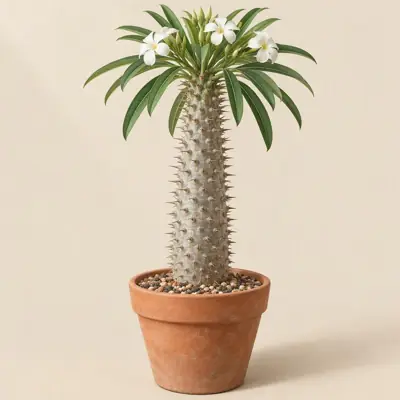
Overview
Pachypodium lamerei is a perennial succulent shrub to small tree with a thick, spiny stem; young plants often have a single columnar main trunk, and the leaves may be shed seasonally.
Origin and habitat
Pachypodium lamerei is native to Madagascar, with some sources more specifically placing it in southern Madagascar. It is reported from dry forests in southern Madagascar, where it can grow in calcareous soil. It is suited to warm, sunny conditions and does not tolerate cold or frost.
Characteristics
Sources differ on mature height, placing it at about 250–600 cm; a single source reports a mature spread of about 150–250 cm. Sources differ on growth rate: cultivated plants are described as generally slow-growing, although faster growth may occur under suitable conditions. Green, narrow to lance-shaped leaves are concentrated near the ends of stems or branches and may be shed during the dry season or winter; mature plants produce fragrant, usually white, funnel-shaped to salver-shaped flowers at the tips, with some sources describing a yellow center or throat. Flowering occurs mainly from spring into early summer and may continue intermittently in warm periods, while RHS records summer flowering; flowering is less common indoors, and a single specialist source reports pod-like fruits that split along their seams when mature and contain many white-winged seeds.
Light
Sources differ somewhat on light conditions, describing full sun or a very bright position as primary conditions while also allowing light shade in warm environments.
Watering
Sources differ somewhat on watering, but during growth Pachypodium lamerei is described as receiving moderate to regular water in well-drained conditions, with water supplied after the mix has dried. During leafless or dormant periods, water is greatly reduced or withheld and conditions are kept relatively dry to avoid rot from prolonged excess moisture.
Humidity and airflow
It is generally reported to prefer low humidity and need good airflow.
Temperature and dormancy
Sources differ on the minimum temperature, with the few available sources placing it at about 5 °C. Sources assign differing USDA hardiness zones, while Pachypodium lamerei is generally reported to be frost tender and should be kept above freezing. It drops its leaves and goes dormant, with dormancy triggered by cold, and it is generally reported to have high heat tolerance.
Growing medium and mounting
Pachypodium lamerei needs a fast-draining, well-aerated growing mix, such as cactus potting mix; RHS also lists chalk, loam, and sandy soils and describes alkaline conditions.
Feeding
Sources differ on feeding practices during active growth: RHS recommends low-nitrogen liquid fertilizer from late spring to early autumn, while genus-level NHK information recommends slow-release fertilizer or diluted liquid fertilizer during spring and autumn growth periods.
Propagation
Pachypodium lamerei can be propagated by seed and cuttings, while some sources also describe propagation from basal offsets.
Common problems
Aphids may occur during flowering, and RHS describes the plant as relatively free of disease overall, although genus-level information notes soft rot under excessively wet conditions. Poor drainage or persistently wet potting mix can lead to rot, prolonged insufficient indoor light can cause elongated growth, and root damage during repotting can be followed by decay or pathogen entry. Pachypodium lamerei is sensitive to frost and low temperatures; even light frost can cause substantial leaf drop, and in cold regions it needs protection from frost or movement indoors.
Identification
Pachypodium lamerei has an upright, thick, gray to greenish-brown succulent trunk densely covered with long spines, while leaves cluster at the stem tips to create a palm-like outline even though the species is not a palm.
Photos


Sources
- Wikipedia (en): Pachypodium lamerei — CC BY-SA 4.0 · link
- Wikipedia (de): Madagaskarpalme — CC BY-SA 4.0 · link
- Wikipedia (fr): Pachypodium lamerei — CC BY-SA 4.0 · link
- Wikipedia (es): Pachypodium lamerei — CC BY-SA 4.0 · link
- LLIFLE Encyclopedia of living forms: Pachypodium lamerei — CC BY-SA · link
- RHS Plants: Pachypodium lamerei — © RHS, facts only · link
- Desert-Tropicals: Pachypodium lamerei — © Philippe Faucon (desert-tropicals.com), facts only · link
- The Succulent Plant Page: Pachypodium (genus-level) — © R.J. Hodgkiss, facts only · link
- 臺北典藏植物園 植物資料庫: Pachypodium lamerei — © 臺北典藏植物園, facts only · link
- NHK みんなの趣味の園芸 植物図鑑: Pachypodium (genus-level) — © NHK出版, facts only · link
- Top Tropicals catalog: Pachypodium lamerei — © Top Tropicals LLC (facts only) · link
- PUKUBOOK: Pachypodium lamerei — CC BY-NC (facts only) · link
- Pachypodium lamerei | Giromagi Cactus and Succulents for sale | Buy plants onlin (www.giromagi.com) — facts only (§12) · link