
Pachypodium bispinosum (Pachypodium bispinosum)
Pachypodium bispinosum is a perennial deciduous succulent shrub and caudiciform plant.
Overview
Pachypodium bispinosum is a perennial deciduous succulent shrub and caudiciform plant.
Origin and habitat
Pachypodium bispinosum is native to South Africa, mainly the Eastern Cape, although sources differ, with some describing its range as including the southern and Eastern Cape. It occurs in arid habitats such as stony ground and rocky slopes in dry succulent scrub, often in sunny positions. It is reported to be adapted to hot, dry environments with prolonged water scarcity, storing water in its swollen succulent stem and underground tuberous root.
Characteristics
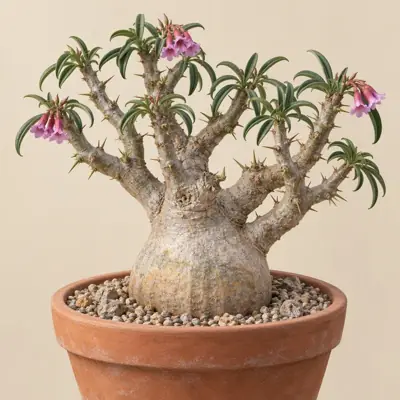
Plants can reach 120 cm in height and have a swollen stem with a large tuberous form. The leaves are narrow, lanceolate to linear-lanceolate, borne either scattered along long shoots or clustered on short shoots; sources differ in their descriptions, which include downward-rolled margins, a leathery texture, and sparse hairs beneath. The terminal, bell-shaped flowers are pale pink to purplish pink with a darker floral tube; sources differ on the flowering season. The fruit is reported to consist of paired follicles that taper at both ends and have a gray, softly hairy surface.
Light
Grow in full sun to bright, light shade, in a position with good sunlight and airflow.
Watering
During active growth, avoid leaving the growing medium waterlogged for prolonged periods; reduce watering gradually in autumn and keep dry during winter dormancy, while sources differ on how much water to provide in summer. It is generally kept slightly dry while in leaf, and water should be withheld while leafless.
Temperature and dormancy
Sources differ on the minimum temperature, placing it at about 4 °C, while specialist-supported information gives a cold minimum of 4 °C. It is reported to tolerate brief light frost and has high heat tolerance. It drops its leaves and goes dormant, with dormancy triggered by cold.
Growing medium and mounting
Use a well-draining medium and avoid waterlogging; genus-level horticultural information gives a mix of akadama, kanuma, pumice, and leaf mold as an example. It is generally reported to need a very fast-draining mix.
Feeding
It is reported that slow-release fertilizer or appropriately diluted liquid fertilizer can be applied during the spring and autumn growing periods.
Propagation
Pachypodium bispinosum can be propagated by seed or cuttings; genus-level information also recommends a sowing period during part of the year.
Common problems
Aphids are reported as a pest, particularly around flowering. Excessively wet growing medium, including during winter, can readily cause rot, so waterlogging and excessive moisture should be avoided. Sources differ on cold sensitivity: cultivated plants are described as sensitive to cold and frost and as needing dry conditions and frost protection during cold periods, while plants in their native habitat are reported to encounter subzero temperatures.
Identification
Pachypodium bispinosum has a large swollen tuberous stem that is partly underground, with branches above bearing paired straight spines. Without flowers, it closely resembles Pachypodium succulentum.
Photos


Sources
- GBIF Backbone: Pachypodium bispinosum (L.fil.) A.DC. — CC BY 4.0 · link
- Wikipedia (en): Pachypodium bispinosum — CC BY-SA 4.0 · link
- Wikipedia (de): Pachypodium bispinosum — CC BY-SA 4.0 · link
- Wikipedia (es): Pachypodium bispinosum — CC BY-SA 4.0 · link
- LLIFLE Encyclopedia of living forms: Pachypodium bispinosum — CC BY-SA · link
- Desert-Tropicals: Pachypodium bispinosum — © Philippe Faucon (desert-tropicals.com), facts only · link
- The Succulent Plant Page: Pachypodium (genus-level) — © R.J. Hodgkiss, facts only · link
- NHK みんなの趣味の園芸 植物図鑑: Pachypodium (genus-level) — © NHK出版, facts only · link
- PUKUBOOK: Pachypodium bispinosum — CC BY-NC (facts only) · link