
Sugared-almond Plant (Pachyphytum oviferum)
Pachyphytum oviferum is a clumping, rosette-forming succulent with short stems that are more upright when young and may later trail or hang. It is an evergreen perennial whose rosettes survive flowering and can flower repeatedly.
Overview
Pachyphytum oviferum is a clumping, rosette-forming succulent with short stems that are more upright when young and may later trail or hang. It is an evergreen perennial whose rosettes survive flowering and can flower repeatedly.
Origin and habitat
Pachyphytum oviferum is native to Mexico and is recorded from San Luis Potosí. It occurs on rocky cliffs and in rock crevices, and a German source reports that its natural population is known from only a single locality. Its native rocky environment is sunny, fast-draining, and relatively dry.
Characteristics
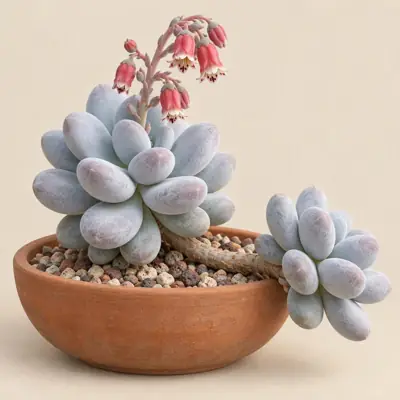
Sources differ on mature size, placing height at about 20–25 cm and spread at about 10–50 cm. It is reported to grow slowly, with thick, succulent, often obovate to ovate leaves densely arranged in rosettes; the leaves range from pale blue-green or silvery blue-green to blue-purple or lavender and commonly have a white powdery coating. The plant stores water in its leaves, and sources differ in describing its arched or elongated inflorescences of pendent, bell-shaped flowers as red or deep reddish orange, with outer parts or sepals ranging from greenish white to powdery in appearance. Sources differ somewhat on flowering time, describing flowering from winter into spring, especially from early spring through spring.
Light
Pachyphytum oviferum prefers abundant sunlight and takes full sun, while also accepting bright indirect light or light shade; some shade is appropriate during the hottest part of midsummer. Ample light helps maintain compact growth, leaf coloration, and flowering.
Watering
Water moderately during active growth; summer watering can be regular provided the growing medium drains well. Reduce watering in winter or keep the plant nearly dry, allowing the medium to dry completely before watering thoroughly and avoiding prolonged wetness.
Humidity and airflow
It is generally reported to prefer low humidity and need good airflow.
Temperature and dormancy
A minimum temperature of 5 °C is given, while the plant tolerates brief light frost. A specialist source reports a cold minimum of about -7 °C, but sources are few for this figure. During intense midsummer heat, avoid the strongest sunlight and provide partial shade; its heat tolerance is somewhat limited.
Growing medium and mounting
Use a well-drained succulent or cactus medium; sandy soil can also be used, and the plant tolerates a relatively broad range of soil acidity and alkalinity. It needs a fast-draining mix and is generally reported to be prone to rot.
Feeding
Fertilizer can be applied in spring and summer using a low-nitrogen fertilizer; another source recommends light feeding in spring and autumn with slow-release or dilute liquid fertilizer, while avoiding overfertilization.
Propagation
Pachyphytum oviferum can be propagated by seed, leaf cuttings, stem cuttings, cuttings, and division of clumping plants. Seed propagation is recommended in spring, while leaf cuttings are recommended in summer.
Common problems
Sources differ in reports of mealybugs, scale insects, and aphids as possible pests; aphids may occur on flower buds during flowering, while scale insects warrant attention during hot, dry periods. Soft rot may occur, with wet conditions and rotting lower leaves associated with greater risk. Insufficient light may cause elongated growth and leaf drop, while excessive watering or fertilizing may cause leaves to split; leaves detach easily, and their powdery coating is readily damaged by touching, skin oils, or overhead watering. It does not tolerate prolonged wetness, and some shade is appropriate in hot midsummer conditions; sources differ on its lower-temperature tolerance.
Identification
Its most distinctive features are rounded, thick leaves resembling eggs or sugar-coated almonds and their blue-gray to white powdery coating.
Photos


Sources
- Wikipedia (en): Pachyphytum oviferum — CC BY-SA 4.0 · link
- Wikipedia (de): Pachyphytum oviferum — CC BY-SA 4.0 · link
- Wikipedia (fr): Pachyphytum oviferum — CC BY-SA 4.0 · link
- Wikipedia (es): Pachyphytum oviferum — CC BY-SA 4.0 · link
- LLIFLE Encyclopedia of living forms: Pachyphytum oviferum — CC BY-SA · link
- RHS Plants: Pachyphytum oviferum — © RHS, facts only · link
- Desert-Tropicals: Pachyphytum oviferum — © Philippe Faucon (desert-tropicals.com), facts only · link
- The Succulent Plant Page: Pachyphytum (genus-level) — © R.J. Hodgkiss, facts only · link
- NHK みんなの趣味の園芸 植物図鑑: Pachyphytum oviferum — © NHK出版, facts only · link
- Pachyphytum oviferum | Giromagi cactus and succulents for sale | Buy plants onli (www.giromagi.com) — facts only (§12) · link
- PUKUBOOK: Pachyphytum oviferum — CC BY-NC (facts only) · link