
Thicket Baboon-Cabbage (Othonna triplinervia)
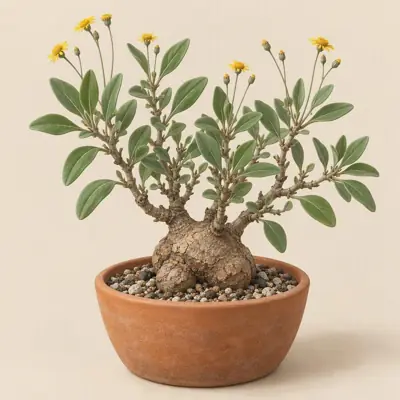
Othonna triplinervia is an evergreen succulent shrub with thick, fleshy stems, an enlarged stem base or caudex, and short, fleshy branches. It is reported to be perennial.
Overview
Othonna triplinervia is an evergreen succulent shrub with thick, fleshy stems, an enlarged stem base or caudex, and short, fleshy branches. It is reported to be perennial.
Origin and habitat
Othonna triplinervia is native to the Eastern Cape of South Africa. It grows on rocky slopes, cliffs, in rock crevices and on rock ledges, and also occurs in scrub; it has been recorded on steep east-facing cliffs with poor quartzitic sandstone soil. One specialist source reports rainfall in both winter and summer in its native habitat, with cooler winters and frost rare or absent.
Characteristics
Sources differ on mature height, giving a range of about 50–200 cm. The leaves cluster at branch tips and are obovate with a tapering base, entire to slightly wavy margins, a somewhat fleshy but soft texture, prominent main veins visible from around the middle of the blade, and light-green to blue-green coloring. The yellow, radiate flower heads have conspicuous ray florets, are borne on long stalks, and form loose terminal corymb-like clusters; sources differ on the flowering season, placing it from autumn into winter in South Africa. The fruit is reported to be a softly hairy achene, and the plant is also reported to have a thickened trunk (pachycaul) and to form a rounded evergreen shrub.
Light
Full sun is the main recommendation, although some sources also consider partial sun acceptable; sunny rock gardens, rocky slopes, or retaining-wall settings are suitable.
Watering
Sources differ on watering: it should be restrained and waterlogging avoided, while one account describes a drier leafless period and another describes moderate watering throughout the year, under which the plant may remain evergreen. One specialist source recommends withholding water while leafless.
Temperature and dormancy
The few available sources report a minimum of about 0 °C. It is frost tender; keep above freezing. One specialist source reports that dormancy varies and that the dormancy trigger is not known.
Growing medium and mounting
A well-drained sandy or loamy soil is suitable, while in its natural habitat it also occurs on poor quartzitic sandstone soil. It is generally reported to need a fast-draining mix.
Propagation
One source reports propagation by cuttings or seed; cuttings can be taken throughout the year and are especially suitable in drier periods, while seed propagation is slower and sowing is recommended from late winter to early spring. Cuttings are generally reported as a propagation method.
Common problems
Waterlogging is reported as a cultivation problem to avoid, especially in winter. Frost should be avoided, and a frost-protected position is suitable; frost is rare or absent in the natural habitat.
Identification
Othonna triplinervia can be recognized by its thick, fleshy and relatively brittle branches, clustered obovate leaves at the branch tips, often leafless lower branches with leaf scars, leaves with prominent main veins, yellow flowers, and a stem base that can become enlarged.
Photos


Sources
- Wikipedia (en, genus): Othonna — CC BY-SA 4.0 · link
- LLIFLE Encyclopedia of living forms: Othonna triplinervia — CC BY-SA · link
- Thicket Baboon Cabbage (Othonna triplinervia) – African Legacy (www.africanlegacy.org.za) — facts only (§12) · link
- PUKUBOOK: Othonna triplinervia — CC BY-NC (facts only) · link
- Othonna triplinervia | Giromagi cactus and succulents for sale | Buy plants onli (www.giromagi.com) — facts only (§12) · link