
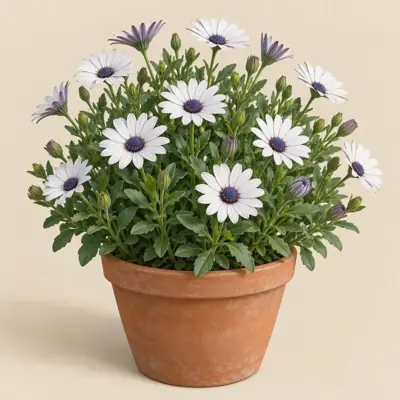
blue and white daisybush (Osteospermum ecklonis)
Osteospermum ecklonis is an evergreen perennial, branching dwarf shrub or subshrub with an upright to spreading habit. It is perennial but is often grown as an annual in cold or frost-prone regions.
Overview
Osteospermum ecklonis is an evergreen perennial, branching dwarf shrub or subshrub with an upright to spreading habit. It is perennial but is often grown as an annual in cold or frost-prone regions.
Origin and habitat
It is native to South Africa's Eastern Cape, particularly around Uitenhage and Humansdorp. Its natural habitats are reported to include the bases of cliffs, steep slopes, moist grassland, and riverbeds. It grows mainly in the subtropical biome, while horticultural cultivation suits warm, sunny, well-drained conditions.
Characteristics
Mature plants reach 50–100 cm in height and 50–100 cm in spread and are reported to grow quickly. Sources describe the leaves differently: they are sessile, somewhat fleshy, and gray-green to green, with shapes ranging among obovate, oblong, elliptic, oblanceolate, and lanceolate and margins from entire to toothed; some accounts describe them as aromatic. The daisy-like flower heads typically have white ray florets with blue-purple to indigo or reddish-blue undersides and dark blue to purple central disc florets, while cultivated forms can have a wider range of flower colors. Sources differ on flowering time by region, variously describing different flowering periods or peak flowering, and the fruit is reported to be an achene-like cypsela with a feathery pappus, with another account describing a reticulately wrinkled surface.
Light
Osteospermum ecklonis grows in full sun.
Watering
It requires a well-drained growing medium and is drought tolerant once established.
Growing medium and mounting
It grows in light to moderately fertile, very well-drained soil, with cultivation recorded in sandy, loamy, or chalky soils under acidic, neutral, and alkaline conditions.
Propagation
It can be propagated by seed or cuttings, with sowing in spring, softwood cuttings taken in late spring, and semi-ripe cuttings taken in late summer.
Common problems
It is generally reported to have few pest problems, although aphids may occur, and few disease problems, although downy mildew and Verticillium wilt may occur. It is reported to escape cultivation and become invasive in unsuitable regions, with invasive records from Victoria and Western Australia. Sources differ in their descriptions of its sensitivity to frost and cold; in frost-prone regions it is generally grown as an annual or overwintered frost-free, and shelter from cold winds is advisable.
Identification
Typical plants are branching evergreen subshrubs with white ray florets, conspicuous dark blue to purple centers, and ray florets whose undersides are usually blue-purple to indigo.
Photos


Sources
- GBIF Backbone: Osteospermum ecklonis (DC.) Norl. — CC BY 4.0 · link
- Wikipedia (en): Dimorphotheca ecklonis — CC BY-SA 4.0 · link
- Wikipedia (en): Osteospermum ecklonis — CC BY-SA 4.0 · link
- Wikipedia (fr): Osteospermum ecklonis — CC BY-SA 4.0 · link
- RHS Plants: Osteospermum ecklonis — © RHS, facts only · link
- USDA PLANTS Database: Osteospermum ecklonis — Public domain (US Government work) · link