
sweet osmanthus (Osmanthus fragrans)
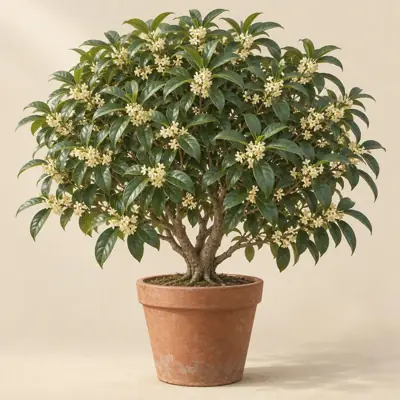
Osmanthus fragrans is an evergreen shrub or small tree that may have a dense, upright, or multi-stemmed habit.
Overview
Osmanthus fragrans is an evergreen shrub or small tree that may have a dense, upright, or multi-stemmed habit.
Origin and habitat
Sources differ on its native range, describing it broadly across Asia, including China, the Himalayan region, India, Nepal, Japan, parts of Southeast Asia, Taiwan, Myanmar, Thailand, Cambodia, and Vietnam. It occurs in mountain and forest environments, including mountainous areas of southern Japan and forests and mountain habitats in the Himalayas and Nepal. It is primarily adapted to subtropical conditions and is also cultivated in tropical and warm-temperate regions.
Characteristics
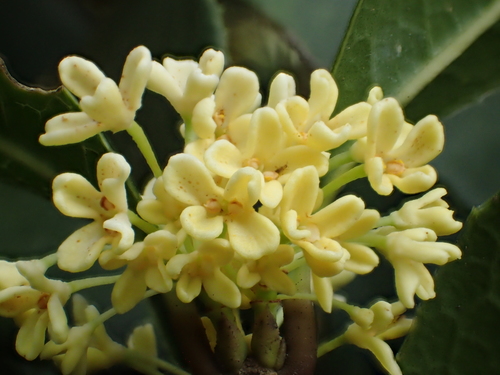
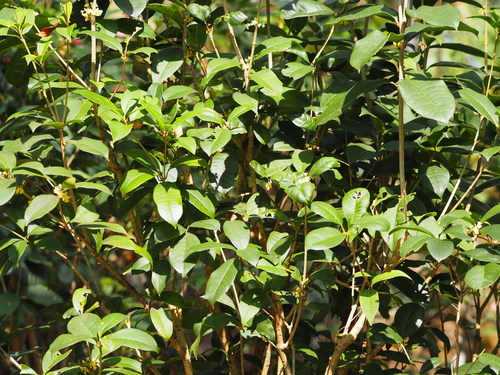
Sources differ on mature height, placing it at about 300–1200 cm, while the few available sources report a mature spread of about 150–250 cm. It is generally reported to grow relatively slowly; sources describe evergreen, leathery, usually opposite leaves that range from elliptic to oblong-elliptic or elliptic-lanceolate, with entire or finely serrated margins and sometimes a glossy dark-green surface. The small, fragrant flowers are commonly clustered in the leaf axils and may be white, creamy white, pale yellow, yellow, or orange-yellow. Sources differ on flowering and fruiting details: autumn is the main flowering season, though flowering may also occur in spring or summer or sporadically for much of the year under some cultivated conditions, and the drupe matures to purple-black, black-brown, or blue-black and contains a hard-shelled seed, maturing in spring after flowering.
Light
It can grow in full sun to partial sun or partial shade; ample light generally favors flowering, while afternoon shade can be provided in hot southern climates and some shade is also more suitable for young plants.
Watering
Keep the growing medium moderately moist but well drained; established plants have some drought tolerance, but water should be supplied in hot, dry conditions, as water shortage during flowering may cause flowers to drop or shorten the flowering period.
Humidity and airflow
It is generally reported to prefer high humidity and to need moderate airflow.
Temperature and dormancy
Sources differ on the lower temperature limit, placing it around -10 °C. The few available sources report an ideal temperature range of about 18–25 °C. A USDA hardiness-zone classification is generally reported, and the plant is generally reported to tolerate brief light frost.
Growing medium and mounting
Sources differ on soil preferences: fertile, well-drained loam or sandy loam is favored, though clay and calcareous soils may also be tolerated; some sources favor humus-rich, slightly acidic soil, while another reports suitability for acidic, neutral, or alkaline soil.
Feeding
A balanced liquid fertilizer is generally reported as suitable for regular application during active growth.
Propagation
It can be propagated by cuttings, air layering, layering, or seed; semi-ripe cuttings are suited to summer, air layering or cuttings can be carried out from spring through autumn, and seeds are best sown soon after ripening.
Common problems
Reported pests include aphids, scale insects, two-banded scale, red-headed flea beetles, and lilac borer or ash clearwing-type pests. Dry, infertile, or compacted poor soil can result in slow growth, sparse branches and foliage, yellowing leaves, and reduced or absent flowering; water shortage during flowering may cause flower drop or shorten the flowering period. It does not tolerate prolonged severe cold and should be protected from cold, dry winds or excessive exposure; some reports indicate that mature plants can briefly withstand light frost and that certain selections have greater cold tolerance. Sooty mold-related problems are generally reported to occur.
Identification
Osmanthus fragrans can be recognized by its evergreen leathery leaves and clusters of small flowers in the leaf axils, with a strong, sweet fragrance; cultivated forms may have white, yellow, or orange-yellow flowers.
Photos


Sources
- Wikipedia (en): Osmanthus fragrans — CC BY-SA 4.0 · link
- 維基百科:桂花 — CC BY-SA 4.0 · link
- Wikipedia (ja): モクセイ — CC BY-SA 4.0 · link
- Wikipedia (de): Süße Duftblüte — CC BY-SA 4.0 · link
- Wikipedia (fr): Olivier odorant — CC BY-SA 4.0 · link
- Wikipedia (es): Osmanthus fragrans — CC BY-SA 4.0 · link
- NC State Plant Toolbox: Osmanthus fragrans — copyright (facts only) · link
- Wikipedia (it): Osmanthus fragrans — CC BY-SA 4.0 · link
- Wikipedia (nl): Osmanthus fragrans — CC BY-SA 4.0 · link
- 農業知識入口網 植物圖鑑: Osmanthus fragrans — © MOA, facts only · link
- Useful Tropical/Temperate Plants: Osmanthus fragrans — CC BY-NC-SA 3.0 (facts only) · link
- RHS Plants: Osmanthus fragrans — © RHS, facts only · link
- Top Tropicals catalog: Osmanthus fragrans — © Top Tropicals LLC (facts only) · link