
angel's-wings (Opuntia microdasys)
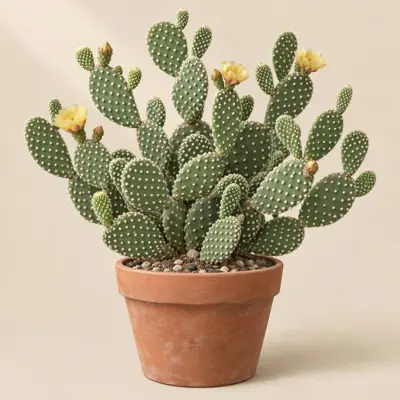
Opuntia microdasys is a perennial, low-growing, much-branched cactus with a shrubby to clumping habit and growth that can range from creeping to nearly upright. It has an opuntioid (pad-forming) growth form.
Overview
Opuntia microdasys is a perennial, low-growing, much-branched cactus with a shrubby to clumping habit and growth that can range from creeping to nearly upright. It has an opuntioid (pad-forming) growth form.
Origin and habitat
Opuntia microdasys is native to central and northern Mexico, including the Chihuahuan Desert and southward to Hidalgo; sources differ on additional areas, including Coahuila, Jalisco, Nuevo León, Querétaro, San Luis Potosí, Tamaulipas, and Zacatecas. It is reported from desert hills, uplands, and xeric scrub, on sandy to loamy calcareous soils. It is adapted to arid and semi-arid environments, is drought tolerant, prefers low humidity, and has limited tolerance of frost or cold.
Characteristics
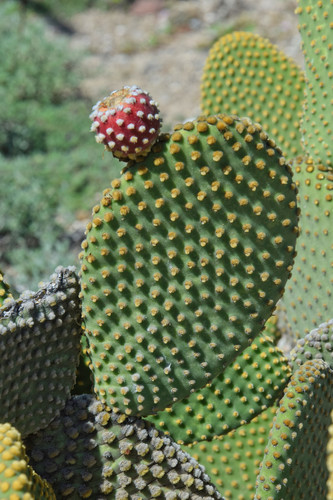
Sources differ on mature size, giving a height of about 50–100 cm and, from few sources, a spread of about 122–152 cm. Sources differ in describing its growth rate as slow to moderate. Sources differ in describing the flowers as yellow to pale yellow, sometimes with reddish tones or red tips; flowering may be uncommon in cultivation and is reported to occur in summer. The nearly spherical fruit becomes dark red to reddish purple when mature; some sources describe white flesh with many seeds and areoles bearing dense glochids on the fruit surface.
Light
Opuntia microdasys takes full sun and can also accept partial shade or bright conditions; ample sunlight supports flowering, although information for the white-glochid form recommends avoiding intense exposure during very hot summers because it can cause sunburn.
Watering
Opuntia microdasys is drought tolerant; in a well-drained medium, allow the medium to dry after watering before watering again, greatly reduce watering during winter dormancy or cool conditions, and avoid prolonged wetness that can lead to root rot.
Humidity and airflow
It is reported to prefer low humidity and need good airflow.
Temperature and dormancy
Sources differ, with few sources indicating a minimum temperature of about 15 °C. Sources differ on its USDA hardiness-zone range. It is described as frost tender and as resting cool in winter with a little water, while a single source reports that it tolerates brief light frost.
Growing medium and mounting
Opuntia microdasys needs a fast-draining, well-aerated cactus mix; loamy, sandy, or mineral-rich media can be used, and its native habitat also includes sandy to loamy calcareous soils.
Feeding
It is reported that a balanced liquid fertilizer can be applied during the spring, summer, and early-autumn growing period, with feeding stopped during winter dormancy.
Propagation
Opuntia microdasys can be propagated by cuttings from stem segments or from seed sown in spring after presoaking.
Common problems
Mealybugs and scale insects are reported as possible problems. Excess water or poor drainage can cause root rot, while intense summer exposure can leave sunburn marks. The white glochids detach very easily and can adhere to skin and clothing, so care is needed when moving the plant. It does not tolerate severe frost or prolonged freezing, and moving it indoors in cold regions is recommended; information for the white-glochid form also recommends avoiding strong direct exposure during very hot summers.
Identification
Opuntia microdasys has flattened, fleshy, oval to nearly round pad-like stem segments and usually lacks the long spines typical of many cacti, instead bearing dense, fine, barbed glochids; in the white-glochid form, these are white and form white, spotted-looking areoles.
Photos


Sources
- Wikipedia (en): Opuntia microdasys — CC BY-SA 4.0 · link
- 維基百科:黄毛仙人掌 — CC BY-SA 4.0 · link
- Wikipedia (de): Opuntia microdasys — CC BY-SA 4.0 · link
- Wikipedia (fr): Opuntia microdasys — CC BY-SA 4.0 · link
- Wikipedia (es): Opuntia microdasys — CC BY-SA 4.0 · link
- GBIF descriptions: DAISIE - Inventory of alien invasive species in Europe — per dataset · link
- NC State Plant Toolbox: Opuntia microdasys — copyright (facts only) · link
- Wikipedia (nl): Opuntia microdasys — CC BY-SA 4.0 · link
- LLIFLE Encyclopedia of living forms: Opuntia microdasys — CC BY-SA · link
- RHS Plants: Opuntia microdasys — © RHS, facts only · link
- USDA PLANTS Database: Opuntia microdasys — Public domain (US Government work) · link
- Desert-Tropicals: Opuntia microdasys — © Philippe Faucon (desert-tropicals.com), facts only · link
- 臺北典藏植物園 植物資料庫: Opuntia microdasys — © 臺北典藏植物園, facts only · link
- Top Tropicals catalog: Opuntia microdasys — © Top Tropicals LLC (facts only) · link