
Kandyan Dancer Orchid (Oncidium sphacelatum)
Oncidium sphacelatum is a tropical herbaceous perennial orchid that usually grows on trees, occasionally grows on rocks, and can form dense colonies. It is reported to be perennial.
Overview
Oncidium sphacelatum is a tropical herbaceous perennial orchid that usually grows on trees, occasionally grows on rocks, and can form dense colonies. It is reported to be perennial.
Origin and habitat
Sources differ on its native range: it extends from southern Mexico through Central America to southeastern Venezuela, while a French-language source explicitly excludes Panama from its natural distribution. It mainly grows on trees and occasionally on rocks in warm, humid lowland habitats. Its climate is tropical, warm, and humid, with the habitat described as lowland by a Spanish-language source.
Characteristics
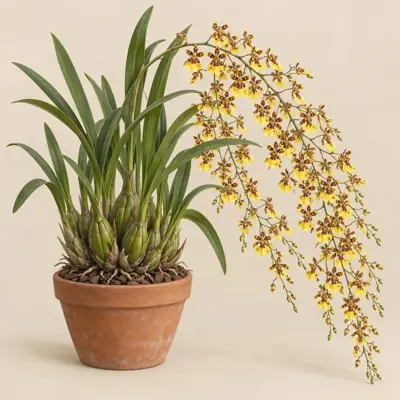
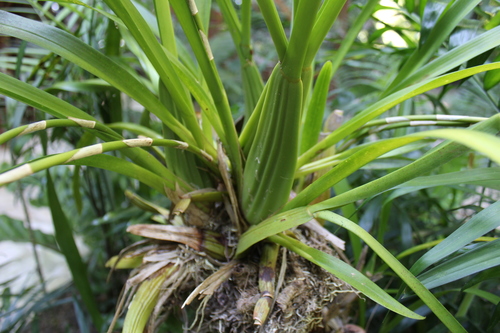
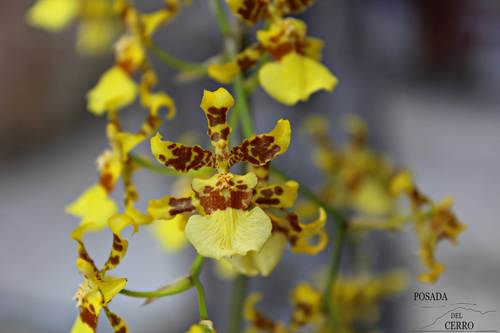
Sources differ, but mature height is about 150 cm. Large pseudobulbs bear elongated, medium-green leaves at their tips; the leaves are also described as narrow, leathery, and oblong to tongue-shaped. The numerous small flowers are mainly bright yellow with brown to purplish-brown markings, borne on large, branched panicles that may arch or hang downward, and the flowers are lightly fragrant. In its native habitat, it is reported to flower early in the year.
Light
Provide bright indirect light to moderate shade; insufficient light may result in poor flowering. Medium light is suitable.
Watering
Water thoroughly during active growth, but let the medium dry between waterings; reduce watering and keep it drier in winter. It is generally recommended to let it dry between waterings.
Humidity and airflow
Evidence is limited to a single source, which reports humidity of about 60–100 %.
Temperature and dormancy
Oncidium sphacelatum is suited to intermediate to warm conditions.
Growing medium and mounting
Use a coarse- to medium-grade, bark-based orchid medium with good aeration and drainage; it can also be grown attached to suitable wood. It is epiphytic. Bark is generally reported as a preferred growing medium.
Feeding
It is reported to benefit from orchid fertilizer diluted with water during the growing season and applied according to the product label.
Propagation
It is reported to be propagated by division in spring.
Common problems
Reported pests include mealybugs and mites, including false spider mites. A source reports relatively few pest and disease problems overall and does not identify a specific disease. Insufficient light may cause poor flowering, and the plant can become too large for a typical windowsill. It is generally suited to tropical conditions and requires high humidity with good airflow; it tolerates dry conditions well during dormancy and can be moved outdoors in summer.
Identification
Oncidium sphacelatum is a large Oncidium with large pseudobulbs, narrow elongated leaves, and very long branched inflorescences bearing numerous small yellow flowers marked with brown or purplish brown.
Photos


Sources
- Wikipedia (en): Oncidium sphacelatum — CC BY-SA 4.0 · link
- Wikipedia (fr): Oncidium sphacelatum — CC BY-SA 4.0 · link
- Wikipedia (es): Oncidium sphacelatum — CC BY-SA 4.0 · link
- NC State Plant Toolbox: Oncidium sphacelatum — copyright (facts only) · link
- Wikipedia (pt): Oncidium sphacelatum — CC BY-SA 4.0 · link
- Internet Orchid Species Photo Encyclopedia: Oncidium sphacelatum — © Jay Pfahl / IOSPE contributors, facts only · link
- AOS culture sheet: Oncidium (genus-level) — © American Orchid Society, facts only · link