
olive tree (Olea europaea)
Olea europaea is an evergreen tree or shrub that is usually much branched, with cultivated forms often growing as small to medium-sized trees. It is a perennial evergreen woody plant that can be very long-lived.
Overview
Olea europaea is an evergreen tree or shrub that is usually much branched, with cultivated forms often growing as small to medium-sized trees. It is a perennial evergreen woody plant that can be very long-lived.
Origin and habitat
Sources differ on its native range: the core range is generally described as the Mediterranean region and nearby parts of Europe, western Asia, and North Africa, while broader accounts extend it into northern Iran, Africa, and Asia; natural distributions of different subspecies may extend into Africa, Arabia, India, and southwestern China. It is reported from dry, rocky woodland and scrub. It favors a Mediterranean-type climate with hot, dry summers and mild, wetter winters, and tolerates drought and high temperatures.
Characteristics
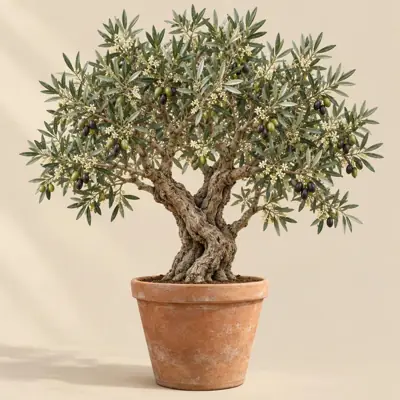
Sources differ on mature height, placing it at about 800–1500 cm, while a limited source reports a mature spread of about 150–250 cm. Growth is slow, and the opposite, leathery leaves range from elliptical to lance-shaped or narrowly inversely ovate, with gray-green to dark green upper surfaces and silvery undersides. The small white to nearly white flowers occur in raceme-like or panicled clusters in the leaf axils, with some sources describing them as fragrant; flowering time varies between hemispheres, and another source broadly describes flowering as occurring in summer. The fruit is a drupe, green when immature and becoming purple-black as it ripens.
Light
Olea europaea prefers full sun and should receive ample light when grown in a greenhouse or indoors.
Watering
It prefers well-drained soil with ordinary moisture conditions; once established it tolerates drought and can grow in dry soil, while prolonged wet conditions should not replace good drainage.
Temperature and dormancy
A limited source reports a minimum temperature of about -10 °C. It is generally assigned a USDA hardiness range, though the available claim provides only qualitative support for that range.
Growing medium and mounting
It prefers deep, fertile, well-drained soil and can grow in loam, while also adapting to chalk, clay, sand, and relatively poor or dry soils; it can grow under acidic, neutral, or alkaline soil conditions.
Propagation
It can be propagated from seed or semi-ripe cuttings, with sowing and cutting carried out at different times of year according to the cited guidance.
Common problems
Scale insects are generally reported as a pest. Mature plants tolerate drought, high temperatures, and salt-laden sea winds, and favor hot, dry summers with mild, wet winters; older plants also show some cold tolerance.
Identification
The evergreen foliage has a conspicuous two-tone effect from silvery leaf undersides and gray-green upper surfaces, while mature trunks are thick and often twisted, knotted, or ruggedly gnarled.
Photos


Sources
- Wikipedia (en): Olea europaea — CC BY-SA 4.0 · link
- 維基百科:油橄欖 — CC BY-SA 4.0 · link
- Wikipedia (ja): オリーブ — CC BY-SA 4.0 · link
- Wikipedia (de): Olivenbaum — CC BY-SA 4.0 · link
- Wikipedia (fr): Olea europaea — CC BY-SA 4.0 · link
- Wikipedia (es): Olea europaea — CC BY-SA 4.0 · link
- GBIF descriptions: Captura y almacenamiento de carbono en el arbolado del Jardín Botánico de Bogotá José Celestino Muti — per dataset · link
- NC State Plant Toolbox: Olea europaea — copyright (facts only) · link
- Useful Tropical/Temperate Plants: Olea europaea — CC BY-NC-SA 3.0 (facts only) · link
- RHS Plants: Olea europaea — © RHS, facts only · link
- USDA PLANTS Database: Olea europaea — Public domain (US Government work) · link