
waterlily (Nymphaea stellata)
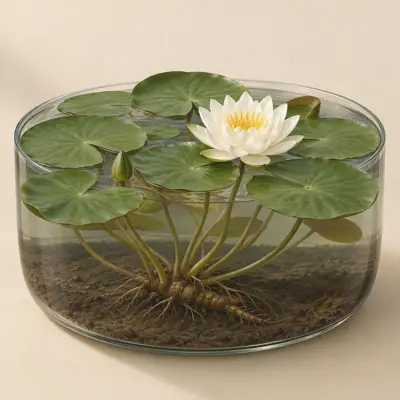
Nymphaea is reported to be an aquatic herbaceous plant, usually anchored in bottom mud by rhizomes or tubers, with leaves mostly floating on the water surface but sometimes submerged or emergent. Sources describe the life cycle differently: Nymphaea is mainly perennial, while some kinds may be annual.
Overview
Nymphaea is reported to be an aquatic herbaceous plant, usually anchored in bottom mud by rhizomes or tubers, with leaves mostly floating on the water surface but sometimes submerged or emergent. Sources describe the life cycle differently: Nymphaea is mainly perennial, while some kinds may be annual.
Origin and habitat
Nymphaea is reported to have a nearly worldwide distribution across North and South America, Africa, Eurasia, and Australia, with a Chinese-language source broadly describing it as occurring worldwide except Antarctica. It is reported to grow in freshwater habitats such as lakes, ponds, lagoons, and slow-moving rivers or streams, usually with rhizomes anchored in bottom mud. Its distribution is reported to extend from tropical to temperate regions, and horticultural groups are generally divided into hardy temperate water lilies and non-hardy tropical water lilies.
Characteristics
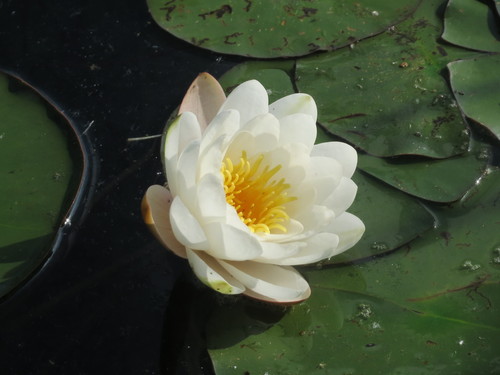
Few sources report a mature height of about 0–200 cm and a mature spread of about 60.96–365.76 cm. Sources describe the leaves differently: they are generally long-stalked and floating, although some kinds may have submerged or emergent leaves; shapes may be ovate, round, elliptic, hastate, or sagittate, often with a deeply divided base and with entire, toothed, or wavy margins. Sources describe the flowers differently: they are usually solitary and may float on, rise above, or occasionally remain below the water; they are bisexual, with sepals, numerous petals and stamens, may be white, yellow, red, pink, purple, or blue, may be fragrant, and different kinds may flower during the day or at night. Flowering is reported in summer, while the fleshy, spongy fruit is nearly spherical to elliptic or berry-like, opens irregularly at maturity, and usually matures underwater after pollination before releasing seeds.
Light
Most kinds are reported to prefer full sun, although some can tolerate some shade.
Watering
Nymphaea is reported to suit still or slowly moving water, with horticultural water depth varying according to plant size.
Temperature and dormancy
Few sources report a minimum temperature of about 15 °C.
Growing medium and mounting
Nymphaea is reported to prefer loam and neutral pH and to be planted in bottom mud or container medium in still or slowly moving water.
Feeding
Nymphaea is reported to have relatively high nutrient needs; in horticultural cultivation, fertilizer intended for water lilies may be used according to the product label.
Propagation
Nymphaea is reported to be propagated by dividing rhizomes or tubers in spring; some kinds can also be propagated vegetatively from stolons, rhizome sections, or plantlets formed on the parent plant, as well as by seed germination.
Common problems
Some taxa are reported to become introduced plants outside their native regions, and some may behave as weeds or encroach on habitats of native aquatic plants. Cold tolerance is reported to vary greatly by horticultural type: tropical types do not tolerate low temperatures and may fail to grow when conditions become too cold, while hardy types can overwinter through winter dormancy.
Identification
Nymphaea is reported to be characterized by floating leaves with deeply divided bases and large solitary flowers borne on long flower stalks; its leaves mainly lie near the water surface, unlike the commonly encountered lotus plants with round, undivided leaves held above the water.
Photos


Sources
- Wikipedia (en): Nymphaea — CC BY-SA 4.0 · link
- 維基百科:睡莲属 — CC BY-SA 4.0 · link
- Wikipedia (ja): スイレン属 — CC BY-SA 4.0 · link
- Wikipedia (de): Seerosen — CC BY-SA 4.0 · link
- Wikipedia (es): Nymphaea — CC BY-SA 4.0 · link
- Wikipedia (it): Nymphaea — CC BY-SA 4.0 · link
- Wikipedia (nl): Nymphaea — CC BY-SA 4.0 · link
- Wikipedia (pt): Nymphaea — CC BY-SA 4.0 · link
- NC State Plant Toolbox: Nymphaea (genus-level) — copyright (facts only) · link