
Egyptian white water-lily (Nymphaea lotus)
Nymphaea lotus is a perennial aquatic herb with rhizomes that can form stolons; its roots are anchored in the bottom, it has submerged and floating leaves, and its flowers rise above the water.
Overview
Nymphaea lotus is a perennial aquatic herb with rhizomes that can form stolons; its roots are anchored in the bottom, it has submerged and floating leaves, and its flowers rise above the water.
Origin and habitat
Sources differ on its native range, which is described as mainly African, including Egypt, tropical to southern Africa, and Madagascar. It grows in freshwater lakes, ponds, rivers, swamps, and other still or slow-moving waters, including mesotrophic to oligotrophic waters; Tanzanian records also place it in sheltered still water at various elevations and depths. It is a tropical to subtropical aquatic plant adapted to warm conditions, with cultivated or naturalized populations also occurring in milder regions.
Characteristics
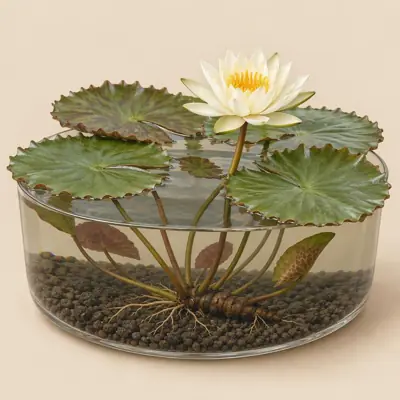
Few sources report a mature height of about 0–45 cm and a mature spread of about 50–100 cm. The leathery floating leaves are round to nearly round, with wavy to toothed margins; the upper surface is usually green and may be reddish, while the underside may range from purplish green to bronze, and cultivated forms may have green leaves with reddish-purple markings or red leaves. Sources differ in their descriptions of the solitary flowers, which rise above the water and are mainly white to creamy white with yellow stamens at the center; they may be fragrant or nearly scentless and open at night, with individual flowers closing in the morning and reopening over several days, mainly from summer into autumn under cultivation. Sources differ on the fruit, described as nearly spherical or fleshy and berry-like, maturing underwater; the seeds are elliptical and have an aril.
Light
Nymphaea lotus grows in full sun or bright conditions.
Watering
It is suited to stable, still water; horticultural sources describe gradually increasing water depth as plants become established, while aquarium cultivation information emphasizes warm water.
Temperature and dormancy
Few sources report an ideal temperature of about 22–28 °C. It is generally reported to be frost tender and should be kept above freezing.
Growing medium and mounting
For horticultural cultivation, loamy soil can be used in an aquatic planting basket; fertile soil can support good growth, although excessive fertility may suppress flowering, and suitable soil types also include clay and loam.
Propagation
It is reported to be propagated vegetatively by separating underground rhizomes, while its seeds can also disperse through water currents.
Common problems
Excessively fertile soil or overly deep water may suppress flowering, and escaped plants can become weeds of rice fields or fish ponds or invasive alien plants in some regions. It prefers warm conditions and cannot safely overwinter outdoors in the usual way in cold regions; in colder areas, it is recommended to be moved to a warm greenhouse for winter.
Identification
Typical identifying features are round floating leaves with toothed margins and white to creamy white flowers that rise above the water and open at night; tiger-striped forms may have conspicuous reddish-purple markings on the leaves.
Photos


Sources
- Wikipedia (en): Nymphaea lotus — CC BY-SA 4.0 · link
- Wikipedia (ja): ヨザキスイレン — CC BY-SA 4.0 · link
- Wikipedia (de): Tigerlotus — CC BY-SA 4.0 · link
- Wikipedia (fr): Nymphaea lotus — CC BY-SA 4.0 · link
- Wikipedia (es): Nymphaea lotus — CC BY-SA 4.0 · link
- GBIF descriptions: Lista de especies de plantas exóticas y trasplantadas de Colombia; Catálogo de Plantas y Líquenes de — per dataset · link
- Wikipedia (pt): Nymphaea lotus — CC BY-SA 4.0 · link
- Useful Tropical/Temperate Plants: Nymphaea lotus — CC BY-NC-SA 3.0 (facts only) · link
- RHS Plants: Nymphaea lotus — © RHS, facts only · link
- USDA PLANTS Database: Nymphaea lotus — Public domain (US Government work) · link