
Egyptian lotus (Nymphaea caerulea)
Nymphaea caerulea is a perennial freshwater aquatic herb with a tuber-like underground stem and leaves that rise from the bottom and float on the water surface.
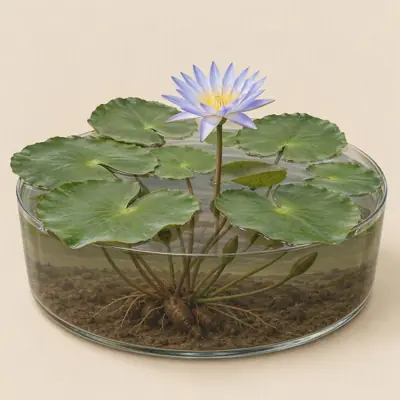
Overview
Nymphaea caerulea is a perennial freshwater aquatic herb with a tuber-like underground stem and leaves that rise from the bottom and float on the water surface.
Origin and habitat
Sources differ on its native range; it is described as primarily native to Africa, extending along the Nile basin into Central, East, and southern Africa, as well as to Yemen and Oman in the southern Arabian Peninsula, with occurrences on Zanzibar, Madagascar, and the Comoros, while introduced or naturalized populations occur in several other parts of the world. It occurs in freshwater rivers, lakes, pools, shallow ponds, and ditches, and can grow in oxygen-poor mud and nutrient-poor waters. It is reported to occur in tropical to subtropical environments.
Characteristics
Its mature spread is reported at about 100–100 cm, based on few sources. The long-stalked, shield-shaped leaves range from nearly round to nearly elliptic with a deep heart-shaped notch; submerged and floating leaves can differ in form and texture, with smooth upper surfaces, prominently raised veins beneath, and thick, dark green to nearly black, spongy stalks. The flowers are usually pale blue-white to sky blue or pale purple, but may also be white or pink, becoming pale yellow toward the center; they have sepals, petals, and numerous stamens, open during the day, and close progressively at night. The fruit is a flattened, rounded berry, while the ellipsoid seeds are smooth and have a fleshy, bell-shaped aril.
Light
Nymphaea caerulea prefers full sun.
Watering
Keep the rhizome submerged in freshwater such as a pond; the species prefers shallow water, while horticultural information for Nymphaea generally favors still or slowly moving water.
Growing medium and mounting
Nymphaea is generally reported to prefer loam with near-neutral pH in still or slowly moving water, while Nymphaea caerulea can also grow in oxygen-poor, relatively nutrient-poor mud.
Feeding
Nymphaea is generally reported to need relatively high nutrient levels in cultivation, and fertilizer intended for water lilies may be applied according to product instructions.
Propagation
Nymphaea caerulea can be propagated from seed or by division. Seeds should be kept moist before sowing and may be sown with the fruit pulp in pots under water; after the first floating leaf appears, seedlings can be potted separately and the water level gradually raised as they grow. Sections of rhizome bearing growth buds can also be cut and initially grown in small submerged pots.
Common problems
Nymphaea is generally reported to be affected by water-lily aphids, water-lily beetles, and gall midges. Crown rot and leaf spot are also reported concerns for Nymphaea. Products commercially sold as “blue lotus” are reported to sometimes be mislabeled with other water lilies and to have inconsistent alkaloid content; naturalized populations in Australia are regarded as environmental weeds.
Identification
Nymphaea caerulea can be recognized by floating shield-shaped leaves, a tuber-like underground stem, and large flowers that are usually pale blue to sky blue or pale purple, fading toward pale yellow at the center; the flowers open during the day and close at night.
Photos


Sources
- GBIF Backbone: Nymphaea caerulea Andrews — CC BY 4.0 · link
- Wikipedia (en): Nymphaea nouchali var. caerulea — CC BY-SA 4.0 · link
- Wikipedia (en): Nymphaea caerulea — CC BY-SA 4.0 · link
- Useful Tropical/Temperate Plants: Nymphaea caerulea — CC BY-NC-SA 3.0 (facts only) · link
- USDA PLANTS Database: Nymphaea caerulea — Public domain (US Government work) · link
- NC State Plant Toolbox: Nymphaea (genus-level) — copyright (facts only) · link