
Bottle-Palm (Nolina recurvata)
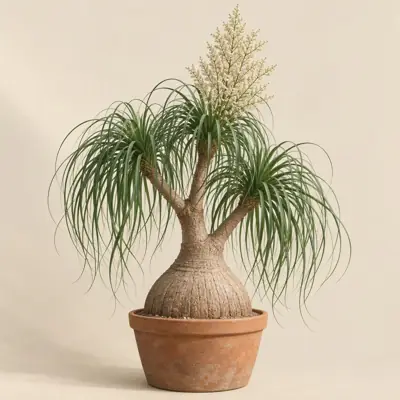
Nolina recurvata is an evergreen perennial, succulent small tree with a woody stem and a swollen, tuber-like stem base; young plants are usually single-stemmed, while older plants may branch.
Overview
Nolina recurvata is an evergreen perennial, succulent small tree with a woody stem and a swollen, tuber-like stem base; young plants are usually single-stemmed, while older plants may branch.
Origin and habitat
Sources differ on its native range in eastern Mexico, with Veracruz, Oaxaca, Puebla, San Luis Potosí, and Tamaulipas among the areas reported. It can grow in rocky, nutrient-poor soils, on cliffs and steep mountain terrain, from full sun to partial shade; natural vegetation includes low deciduous forest, while sources differ substantially on elevation. Its native environment has a pronounced dry season, and the plant is drought tolerant.
Characteristics
Sources differ, with few sources placing mature height at about 150–250 cm, while a single source reports a mature spread of about 100–150 cm. Growth is very slow, and the green to dark-green, linear or strap-like leaves are thin, narrow, flat or slightly ridged, spreading outward before recurving and drooping in tufts at the ends of stems or branches. Mature plants can produce large, branched panicles bearing many small white, creamy white to yellowish-cream flowers; flowering is reported to occur occasionally after maturity, mainly from late spring through summer and to last for several weeks. The plant stores water in its stem, and a specialist source reports red, winged fruits containing seeds.
Light
Nolina recurvata takes full sun and can also grow in bright, light shade; indoors, it should receive abundant bright light or sunlight.
Watering
It is drought tolerant; during the growing season it can be watered thoroughly while allowing the growing medium to dry between waterings, with water greatly reduced in winter and overwatering avoided. In winter, water only enough to keep the leaves from wilting or the medium slightly moist.
Temperature and dormancy
Sources differ, with few sources placing a minimum temperature at about 10 °C, while another single source gives about 0 °C as a cold minimum. A single source reports a USDA hardiness-zone classification, while a specialist source reports that Nolina recurvata tolerates brief light frost.
Growing medium and mounting
It needs a well-drained medium and can be grown in a loam-based potting mix; suitable soil types listed by RHS include chalk, clay, loam, and sand, with acidic, neutral, or alkaline conditions. It needs a fast-draining mix, and a specialist source generally reports low rot risk.
Feeding
A specialist source reports feeding once during the summer growing period.
Propagation
It can be propagated from seed sown in spring; other reported methods include cuttings and rooted offsets in spring.
Common problems
Potential pests include mealybugs, scale insects, and mites, with RHS specifically listing greenhouse red spider mite. A single source generally reports few disease problems. Overwatering is a common cause of cultivation failure and may increase pest problems, while leaf tips can readily dry and turn brown indoors. It is drought tolerant, but sources vary widely on cold tolerance; conservative cultivation information treats it as frost-sensitive and recommends protection from freezing in cold or winter-frost areas.
Identification
The strongly swollen stem base forms a conspicuous water-storage structure beneath a narrower upper stem, with clusters of long, narrow, recurved and drooping leaves at the branch tips; it looks palm-like but is not a true member of the palm family.
Sources
- GBIF Backbone: Nolina recurvata (K.Koch & Fintelm.) Hemsl. — CC BY 4.0 · link
- Wikipedia (en): Beaucarnea recurvata — CC BY-SA 4.0 · link
- Wikipedia (en): Nolina recurvata — CC BY-SA 4.0 · link
- TaiCOL 臺灣物種名錄: Nolina recurvata — CC BY 4.0 · link
- LLIFLE Encyclopedia of living forms: Nolina recurvata — CC BY-SA · link
- RHS Plants: Nolina recurvata — © RHS, facts only · link
- The Succulent Plant Page: Beaucarnea (genus-level) — © R.J. Hodgkiss, facts only · link
- Top Tropicals catalog: Nolina recurvata — © Top Tropicals LLC (facts only) · link
- PUKUBOOK: Nolina recurvata — CC BY-NC (facts only) · link