
Oleander (Nerium oleander)
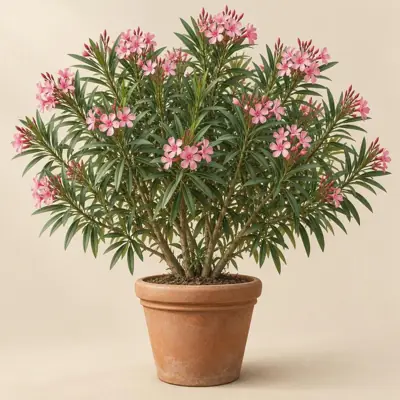
Nerium oleander is a perennial evergreen woody shrub or small tree with an upright, often multi-stemmed habit, and it can be trained as a single-trunk small tree.
Overview
Nerium oleander is a perennial evergreen woody shrub or small tree with an upright, often multi-stemmed habit, and it can be trained as a single-trunk small tree.
Origin and habitat
Sources differ on its native range, which is described mainly as extending from the Mediterranean region, North Africa, and southern Europe eastward to South Asia, with Morocco, Portugal, India, and Myanmar explicitly included by multiple sources and Yunnan, China, treated as native by some floristic sources. In natural settings it occurs along riverbanks, on river gravels, and in seasonally dry rocky watercourses, with records also from dry riverbeds. It is adapted to semi-arid warm-temperate to subtropical climates and is also widely cultivated in tropical, subtropical, and mild-winter temperate regions; it tolerates heat and drought.
Characteristics
Sources differ on mature height, placing it at about 200–600 cm, while a single source reports a mature spread of about 183–305 cm. It grows rapidly and has thick, leathery, dark green, narrow leaves with entire margins, commonly arranged oppositely in pairs or in whorls. Flowers are clustered at branch tips and typically have a tubular base and lobed corolla; wild forms are commonly pink to rose-red, while cultivated forms also include white, red, yellow, purple, and orange flowers and double-flowered forms, and some plants or cultivars are sweetly fragrant while others are not. Flowering is mainly from late spring through summer and can continue into early autumn or autumn in warm regions; the fruit is reported to be a slender follicle, commonly paired, which splits at maturity to release many hairy or downy seeds.
Light
Full sun is best, although partial shade is tolerated, and ample sunlight suits its growth and flowering.
Watering
Mature plants have good drought tolerance and can also withstand some flooding, but this does not mean prolonged waterlogging is suitable; a well-drained growing medium is preferred.
Temperature and dormancy
Sources differ on minimum temperature, with a reported value of about -5 °C. It tolerates brief light frost. A single source reports a USDA hardiness-zone range.
Growing medium and mounting
It prefers fertile, well-drained soil and has some adaptability to soil conditions, including tolerance of calcareous and saline-alkaline conditions; sources differ over whether lighter or heavier soils are preferred.
Propagation
It is reported to be propagated by seed or stem cuttings.
Common problems
Recorded pests include oleander aphids, milkweed bugs, scale insects, and some moth larvae that feed on new shoots, flower buds, or leaves. Sooty mold is reported to occur and is also listed as a problem associated with pest secretions. Cold conditions or severe winters can cause frost damage to branches; the plant tolerates heat, drought, and periodic flooding but not prolonged frost, and cold injury may occur around or below freezing.
Identification
It is reported to be an upright evergreen woody plant with thick, leathery, narrow leaves that are commonly whorled or opposite, conspicuous funnel-shaped lobed flowers at branch tips, and slender fruits that release hairy seeds when mature.
Photos


Sources
- Wikipedia (en): Nerium — CC BY-SA 4.0 · link
- 維基百科:夾竹桃 — CC BY-SA 4.0 · link
- Wikipedia (ja): キョウチクトウ — CC BY-SA 4.0 · link
- Wikipedia (de): Oleander — CC BY-SA 4.0 · link
- Wikipedia (fr): Laurier-rose — CC BY-SA 4.0 · link
- NC State Plant Toolbox: Nerium oleander — copyright (facts only) · link
- Wikipedia (it): Nerium oleander — CC BY-SA 4.0 · link
- Wikipedia (nl): Oleander — CC BY-SA 4.0 · link
- Useful Tropical/Temperate Plants: Nerium oleander — CC BY-NC-SA 3.0 (facts only) · link
- USDA PLANTS Database: Nerium oleander — Public domain (US Government work) · link
- Top Tropicals catalog: Nerium oleander — © Top Tropicals LLC (facts only) · link