
Cornish Lily (Nerine bowdenii)
Nerine bowdenii is a perennial, clump-forming bulbous herb with upright flower stems.
Overview
Nerine bowdenii is a perennial, clump-forming bulbous herb with upright flower stems.
Origin and habitat
Nerine bowdenii is native to South Africa, with more detailed records including Eastern Cape, KwaZulu-Natal, Free State and the Drakensberg. It can be cultivated in temperate regions and prefers warm conditions; colder regions require sheltered protection, while tropical or very humid climates are unsuitable.
Characteristics
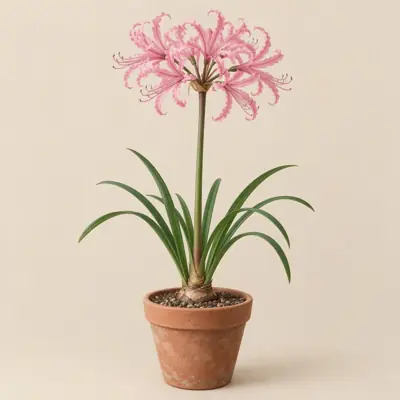
Sources differ on mature height, placing it at about 45–50 cm, while mature spread is 8–10 cm. The green leaves are strap-shaped or linear; the flower stems and flowers may appear before the leaves, which grow in spring before entering a dormancy cycle. The pink, lily-like, lightly fragrant flowers form large terminal umbels, with wavy, recurved perianth segments. Flowering occurs from late summer into autumn, mainly in autumn.
Light
Grow in full sun, preferably in a sheltered east-, west- or south-facing position.
Watering
Water is needed while the plant is growing and in leaf, but the growing medium should drain well; stop watering while the bulb is dormant and avoid prolonged excessive moisture.
Temperature and dormancy
A single source reports a minimum temperature of about -15 °C; sources are few for this figure.
Growing medium and mounting
Use well-drained, moderately fertile soil; Nerine bowdenii can adapt to chalk, clay, loam or sand and to acidic, neutral or alkaline soil.
Propagation
It is reported to be propagated by division after flowering or by bulb cutting; some Nerine can also be propagated from seed, but the seed does not store well and seedlings may take a long time to flower.
Common problems
Slugs and Narcissus bulb fly may cause damage. Sources describe disease differently: infection with vallota mosaic virus has been recorded, while the RHS describes general horticultural disease risk as usually low. Poor drainage or excessive moisture is unsuitable, watering should not continue during dormancy, and plants in cold regions need winter protection. It does not tolerate tropical or very humid weather, and in cold regions it requires shelter or dry covering.
Identification
Nerine bowdenii is a bulbous plant with pink umbels at the tips of upright, nearly leafless flower stems, and its strap-shaped leaves appear at a different time from the flowers; its pink flowers distinguish it from the red-flowered Nerine sarniensis described by the sources.
Photos

