
Boston swordfern (Nephrolepis exaltata)
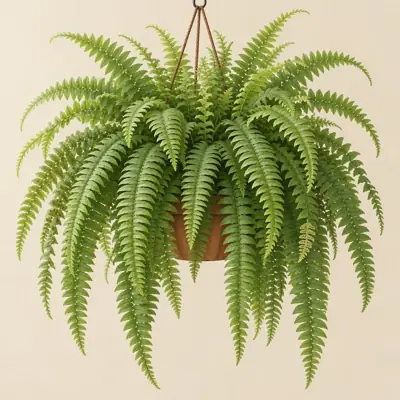
Nephrolepis exaltata is a terrestrial, evergreen perennial fern with rhizomes and creeping runners that can form clumps. Boston-type cultivars have gracefully drooping or arching fronds suited to hanging containers.
Overview
Nephrolepis exaltata is a terrestrial, evergreen perennial fern with rhizomes and creeping runners that can form clumps. Boston-type cultivars have gracefully drooping or arching fronds suited to hanging containers.
Origin and habitat
Sources differ on the native range: its core distribution is described as tropical to subtropical parts of the Americas, including Florida, Mexico, Central America, the Caribbean, and South America, while some sources additionally include Africa, Oceania, Polynesia, or tropical parts of Asia. It occurs in moist, shaded habitats, including moist forests, swamps, and floodplains, and may grow terrestrially or as an epiphyte, with growth on rocks less common. It is primarily adapted to warm, humid tropical to subtropical environments.
Characteristics
Sources differ on mature height, placing it at about 40–100 cm. According to limited source evidence, mature spread is about 100–150 cm. The fronds are pinnately compound; those of 'Bostoniensis' are long and drooping or arching, while the species has linear-lanceolate to narrowly elongated pinnae, with sources differing on frond dimensions. It is reported to have an erect rhizome.
Light
Provide bright indirect light to bright partial shade and avoid strong direct sunlight; indoors during winter, sunlight filtered through glass can be provided.
Watering
During the growing season, keep the medium evenly moist but well drained, avoiding both complete drying and prolonged waterlogging; in winter, reduce watering and water again after the medium begins to dry.
Humidity and airflow
Nephrolepis exaltata prefers high humidity and has a high humidity need. It is generally reported to need moderate airflow.
Temperature and dormancy
The ideal temperature is 15–25 °C, with a maximum of 25 °C. Limited sources differ on the minimum temperature, which is about 5 °C. It is tender, and hardiness guidance describes it as suitable for relatively warm conditions, with colder areas generally treating it as an indoor plant.
Growing medium and mounting
Use a humus-rich or nutrient-rich medium that is loose, aerated, and well drained; loamy or sandy media and acidic to neutral conditions are suitable.
Feeding
Fertilizer may be applied regularly during the growing season, although sources recommend differing schedules and fertilizer types, including balanced liquid, slow-release, and fast-acting liquid fertilizers.
Propagation
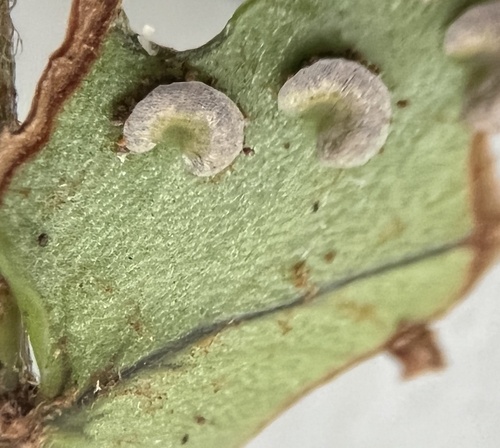
Propagation can be by division or by separating rooted plantlets formed on creeping runners; the species can also be propagated by spore, but Boston ferns are reported mostly not to produce spores, giving stronger source support to vegetative propagation for cultivars. Sources also describe the species as capable of forming spores on the undersides of the fronds. Division can be used for propagation, with source guidance calling for removing some potting medium and thinning some fronds during the process.
Common problems
Possible pests include scale insects and slugs; other sources also list Florida fern caterpillar and fern scale insect. Anthracnose may occur, and fronds may rot when they remain wet for prolonged periods. Allowing the potting medium to dry completely may impair growth, while overwatering can cause root rot; prolonged wetness can also rot fronds, and overhead summer watering is reported to cause frond damage under persistently damp conditions. It has weak cold tolerance and favors warm conditions; frost can make the above-ground fronds appear completely dead, and in cold regions it is best moved indoors for winter.
Identification
Key ornamental features are long, flexible, arching fronds, with pinnae arranged on both sides of the rachis and nearly round sori on the undersides of the fronds. Creeping stems and the absence of tubers are also described as features distinguishing it from some similar Nephrolepis ferns.
Photos


Sources
- GBIF Backbone: Nephrolepis exaltata (L.) Schott — CC BY 4.0 · link
- Wikipedia (en): Nephrolepis exaltata — CC BY-SA 4.0 · link
- 維基百科:波士頓腎蕨 — CC BY-SA 4.0 · link
- Wikipedia (ja): セイヨウタマシダ — CC BY-SA 4.0 · link
- Wikipedia (de): Nephrolepis exaltata — CC BY-SA 4.0 · link
- Wikipedia (fr): Nephrolepis exaltata — CC BY-SA 4.0 · link
- GBIF descriptions: Catálogo de Plantas y Líquenes de Colombia; DAISIE - Inventory of alien invasive species in Europe; — per dataset · link
- NC State Plant Toolbox: Nephrolepis exaltata — copyright (facts only) · link
- Wikipedia (nl): Nephrolepis exaltata — CC BY-SA 4.0 · link
- RHS Plants: Nephrolepis exaltata — © RHS, facts only · link
- USDA PLANTS Database: Nephrolepis exaltata — Public domain (US Government work) · link
- 臺北典藏植物園 植物資料庫: Nephrolepis exaltata — © 臺北典藏植物園, facts only · link
- NHK みんなの趣味の園芸 植物図鑑: Nephrolepis exaltata — © NHK出版, facts only · link