
N. ventricosa (Nepenthes ventricosa)
Nepenthes ventricosa is reported to be an evergreen, climbing carnivorous plant that may grow terrestrially or as an epiphyte, with stems that can climb on other plants. It is reported to be a perennial evergreen plant.
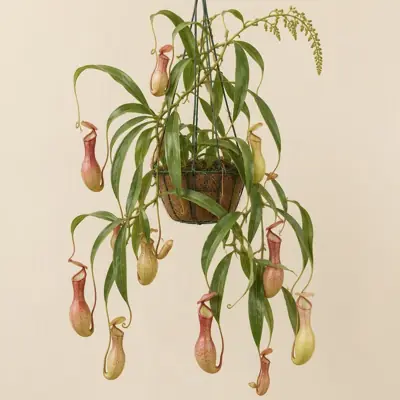
Overview
Nepenthes ventricosa is reported to be an evergreen, climbing carnivorous plant that may grow terrestrially or as an epiphyte, with stems that can climb on other plants. It is reported to be a perennial evergreen plant.
Origin and habitat
Sources differ on details of its recorded distribution, but describe Nepenthes ventricosa as endemic to the Philippines, with records from Luzon, Panay and Sibuyan. Sources differ in their accounts of its habitat, describing montane highland environments including montane forest and cloud zones. It is associated with tropical highland conditions; cultivation sources indicate that it adapts to a relatively broad range of environments but generally grows better under intermediate to highland conditions.
Characteristics
Sources differ, placing mature height at about 200–600 cm. The leaves are reported to be narrow and linear to lanceolate, without a conspicuous petiole, with the base clasping roughly half the stem; their surface is smooth and has also been described as leathery. The species is reported to be dioecious, with female and male flowers on separate plants; the flowers have also been described as unisexual, borne in panicle-like inflorescences, with green to dark brown perianth segments.
Light
Nepenthes ventricosa is suited to bright light; cultivation sources recommend either very bright indirect light or a sunny windowside position.
Watering
Keep the growing medium moist without making it overly wet; genus-level horticultural information recommends not allowing the potting medium to dry out from spring through autumn and watering after the medium dries in winter. It is generally recommended to keep it evenly moist. It is reported to require pure water only (rain, RO or distilled).
Humidity and airflow
It is reported to prefer low humidity.
Temperature and dormancy
With few sources, the reported temperature bounds are about 5 °C to 35 °C. It is reported to tolerate brief light frost.
Growing medium and mounting
Long-fiber sphagnum, perlite and optional orchid bark may be used; genus-level information also recommends sphagnum alone or a humus-rich, well-drained medium. Sphagnum with perlite is also recommended.
Feeding
Cultivation sources recommend feeding the pitchers with Maxsea or liquid orchid fertilizer; genus-level sources also describe using either slow-release fertilizer in summer or fast-acting liquid fertilizer. Maxsea or liquid orchid fertilizer is reported to be suitable for adding to the pitchers periodically.
Propagation
It is reported to be propagated from stem cuttings; genus-level guidance describes taking sections of vine with several nodes, removing the lower leaves, shortening the top leaf, inserting the cutting into sphagnum and keeping it from drying out until it roots.
Common problems
Scale insects and aphids are reported as possible pests. Leaf spot is reported as a possible disease, with genus-level information indicating that it mainly occurs from spring through autumn. Excessive heat may impair growth, while the growing medium should remain moist without becoming overly wet. Sources differ in describing weather sensitivity: the species is described as having some tolerance of low temperatures and lower air humidity, while another source describes it as somewhat sensitive to heat and recommends shade during extreme summer heat.
Identification
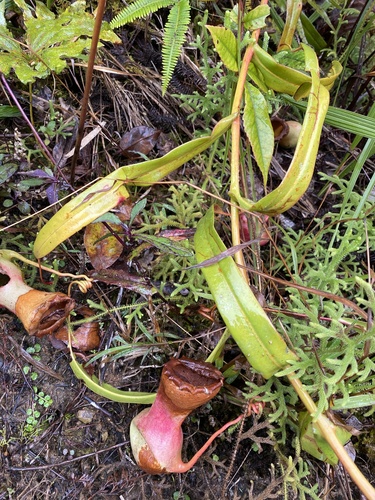
The pitchers have a conspicuously constricted middle, an enlarged lower portion and a more funnel-shaped upper portion; many pitchers may be present at the same time, with colors ranging from ivory and creamy white through pinkish orange to red. Nepenthes ventricosa is closely related to N. burkei and N. sibuyanensis and can generally be distinguished by a more constricted pitcher middle, a smaller pitcher opening and a thinner peristome.
Photos


Sources
- Wikipedia (en): Nepenthes ventricosa — CC BY-SA 4.0 · link
- 維基百科:葫芦猪笼草 — CC BY-SA 4.0 · link
- Wikipedia (ja): ネペンテス・ベントリコーサ — CC BY-SA 4.0 · link
- Wikipedia (de): Nepenthes ventricosa — CC BY-SA 4.0 · link
- Wikipedia (fr): Nepenthes ventricosa — CC BY-SA 4.0 · link
- Wikipedia (it): Nepenthes ventricosa — CC BY-SA 4.0 · link
- Wikipedia (nl): Nepenthes ventricosa — CC BY-SA 4.0 · link
- Tom's Carnivores: Nepenthes ventricosa — © Tom's Carnivores, facts only · link
- NHK みんなの趣味の園芸 植物図鑑: Nepenthes ventricosa — © NHK出版, facts only · link
- NC State Plant Toolbox: Nepenthes (genus-level) — copyright (facts only) · link
- Nepenthes ventricosa Pitcher Plant – California Carnivores (www.californiacarnivores.com) — facts only (§12) · link
- Tropical pitcher plant 'Nepenthes ventricosa' 'Alba' 'M' (www.araflora.com) — facts only (§12) · link