
Common Swamp Pitcher-Plant (Nepenthes mirabilis)
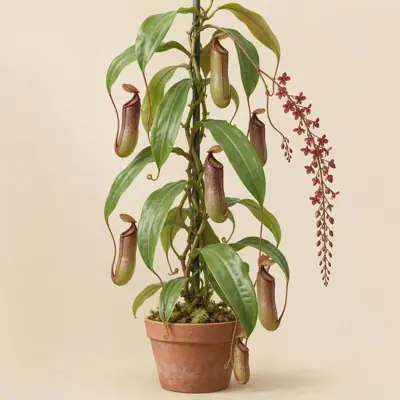
Nepenthes mirabilis is reported to grow from an upright herb into a climbing vine, remaining shorter in open environments and climbing in denser vegetation. It is reported to be perennial.
Overview
Nepenthes mirabilis is reported to grow from an upright herb into a climbing vine, remaining shorter in open environments and climbing in denser vegetation. It is reported to be perennial.
Origin and habitat
Sources differ on the details of its very broad range, which extends from southern China, Hong Kong, and Macau through mainland Southeast Asia, the Malay Archipelago and surrounding islands to New Guinea and Australia's Cape York Peninsula; records include Cambodia, Laos, Myanmar, Thailand, Vietnam, the Malay Peninsula, Borneo, Sumatra, Java, Sulawesi, the Moluccas, the southern Philippines, Palau, Yap, and various other western Pacific and Southeast Asian islands. It is reported to occur mainly in open, wet to swampy habitats, including sandy soils, and occasionally in denser vegetation. It is reported to occur mainly in tropical low-elevation environments, often only slightly above sea level, with records also from higher elevations.
Characteristics
Sources differ, but the few available sources indicate a mature height of about 50–1000 cm. Sources differ in their descriptions of the leaves: basal rosette leaves are densely arranged, nearly stalkless to stalkless, and mainly lance-shaped, while leaves on climbing stems are stalked and range from oblong or lance-shaped to broader linear-lance-shaped forms; the leaf tip extends into a tendril connected to the pitcher. Sources differ in their descriptions of the flowers, which are borne in racemes with red to purplish-red, elliptic to oblong perianth segments; male and female flowers differ slightly in the size of their floral parts. A flowering season is reported, and the fruit is reported to be a chestnut-colored capsule with narrow lance-shaped valves and threadlike seeds, with a distinct fruiting season.
Light
Nepenthes cultivation is generally reported to require a bright environment, with recommendations including bright indirect light or partial sun and as much sun as possible during the growing part of the year; requirements may vary among species and growing conditions. Bright light is generally recommended.
Watering
During active growth, keep the medium moist while avoiding prolonged waterlogging; in winter, watering can wait until the medium becomes drier, and misting or environmental spraying is also recommended to maintain higher air humidity. Low-mineral water is generally reported to be fine, and the moisture target is to keep evenly moist.
Humidity and airflow
It prefers high humidity.
Temperature and dormancy
It is generally reported to have no dormancy.
Growing medium and mounting
Use a moisture-retentive but well-drained, acidic medium; cited examples include sphagnum moss, unfertilized peat, bark, coconut chunks, akadama, and orchid medium containing sphagnum moss or added peat. Sphagnum moss is generally reported as a substrate type.
Feeding
Horticultural information for Nepenthes generally recommends slow-release chemical fertilizer or fast-acting liquid fertilizer during summer growth.
Propagation
It can be propagated from cuttings, using a healthy vine or shoot tip; lower leaves are removed, remaining leaves may be trimmed, and a moisture-retentive medium such as sphagnum moss can be used while roots develop.
Common problems
Nepenthes cultivation is reported to be susceptible to scale insects and aphids; aphids mainly affect new leaves, while scale insects can occur on leaves and stems. The leaves and pitchers of this species are reported to have a softer texture, with pitchers that are less durable and wilt more readily. Horticultural information for Nepenthes generally describes low cold tolerance, strong heat tolerance, and a need for higher air humidity.
Identification
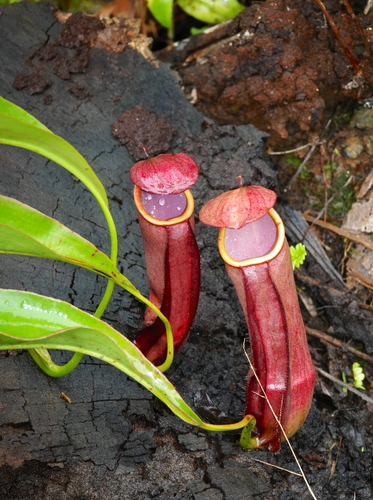
It is reported to bear pitchers formed from tendrils extending from the leaf tips; lower pitchers usually have paired winged fringes, while upper pitchers are nearly cylindrical and have wings reduced to ridges. Pitcher shape and color are reported to vary greatly among localities.
Photos


Sources
- Wikipedia (en): Nepenthes mirabilis — CC BY-SA 4.0 · link
- 維基百科:奇異豬籠草 — CC BY-SA 4.0 · link
- Wikipedia (de): Nepenthes mirabilis — CC BY-SA 4.0 · link
- Wikipedia (es): Nepenthes mirabilis — CC BY-SA 4.0 · link
- Wikipedia (it): Nepenthes mirabilis — CC BY-SA 4.0 · link
- 農業知識入口網 植物圖鑑: Nepenthes mirabilis — © MOA, facts only · link
- USDA PLANTS Database: Nepenthes mirabilis — Public domain (US Government work) · link
- Tom's Carnivores: Nepenthes (genus-level) — © Tom's Carnivores, facts only · link
- NHK みんなの趣味の園芸 植物図鑑: Nepenthes (genus-level) — © NHK出版, facts only · link
- NC State Plant Toolbox: Nepenthes (genus-level) — copyright (facts only) · link