
Flask-Shaped Pitcher-Plant (Nepenthes ampullaria)
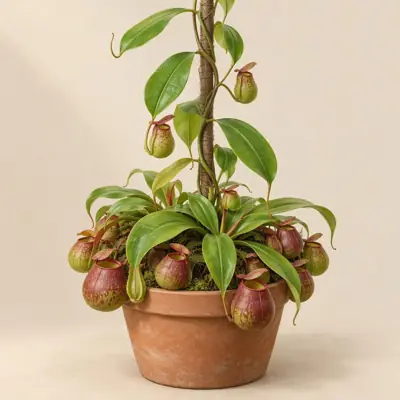
Nepenthes ampullaria is reported to be a climbing, perennial evergreen plant, with multiple short rosette-forming side shoots emerging from the base or older woody stems. It is reported to be perennial and evergreen.
Overview
Nepenthes ampullaria is reported to be a climbing, perennial evergreen plant, with multiple short rosette-forming side shoots emerging from the base or older woody stems. It is reported to be perennial and evergreen.
Origin and habitat
It is reported as native to Borneo, the Moluccas, New Guinea, the Malay Peninsula, Singapore, Sumatra and Thailand, with additional records from Bangka, Bengkalis, Lanta, Daru, Langkawi, the Mentawai Islands, Nias, Penang and the Riau Islands. Sources describe the habitat differently, but records include moist, shaded forests and wetlands, such as peat swamp forest, heath forest, degraded swamp forest, shallow-water areas and lowland wetlands, as well as Araucaria forest, secondary forest and lowland wetland vegetation in New Guinea; records span from sea level to higher elevations, while many regional records are concentrated at lower elevations. It occurs in tropical, humid environments, with moist lowland forest and swamp forest as typical habitats.
Characteristics
Sources differ on mature height, reporting about 1500–1500 cm. Sources describe the usually pale-green leaves differently; climbing stems may bear elliptic to oblong leaves, while short basal side shoots form rosettes. It is reported to have dense panicles and to be dioecious, with flowers ranging from red to olive-brown. It is reported to flower repeatedly over the year, with each flowering period lasting several weeks, but no fixed months or season are given.
Light
Sources differ on general Nepenthes cultivation: bright light is recommended, with some guidance favoring bright diffuse light or partial sun while avoiding substantial direct sunlight, and other guidance favoring as much outdoor sunlight as possible from spring through autumn and ample sunlight through glass in winter. Medium light is generally indicated.
Watering
It is generally recommended to keep the growing medium moist during active growth and avoid letting it dry out; in winter, watering may wait until the medium is drier, while misting the leaves may help maintain higher air humidity. Misting plus top watering is generally recommended, with a target to keep evenly moist.
Humidity and airflow
Nepenthes ampullaria generally prefers high humidity.
Temperature and dormancy
It is generally described as having no dormancy.
Growing medium and mounting
General Nepenthes potting guidance reports that sphagnum moss or a humus-rich, well-drained medium may be used, and also mentions sphagnum moss or orchid medium combined with peat. Sphagnum moss is generally indicated as a substrate type.
Feeding
General Nepenthes horticultural guidance reports the use of either slow-release chemical fertilizer or fast-acting liquid fertilizer during the summer growing period. Nepenthes ampullaria is reported to be partly detritivorous, collecting and digesting fallen leaves in its pitchers to obtain nutrients.
Propagation
It is reported to be propagated by stem cuttings taken from vine sections with several nodes; lower leaves are removed, upper leaves are trimmed, and the cuttings are placed in sphagnum moss under bright shade while the moss is kept moist, with rooting reported after a period of time.
Common problems
General Nepenthes horticultural information reports scale insects and aphids as pests. General Nepenthes horticultural information reports that leaf spot may occur, mainly from spring through autumn. General Nepenthes horticultural information describes low cold tolerance and high heat tolerance, with warm, highly humid conditions required.
Identification
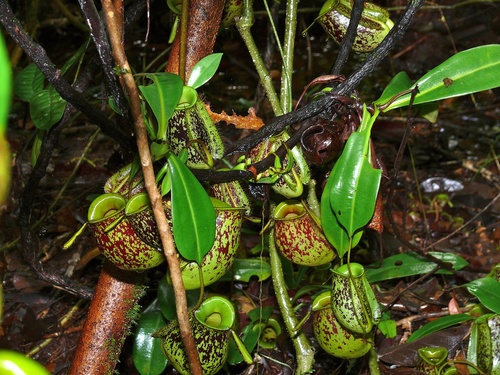
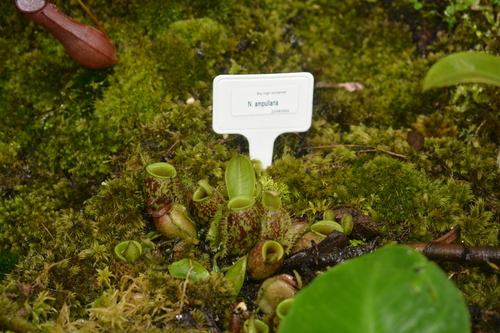
Sources describe Nepenthes ampullaria as having rounded to jar-shaped pitchers, with ground pitchers often densely carpeting the surface; the pitchers are generally small and upper pitchers are rare. Its nutritional strategy is described as differing from that of most Nepenthes: it collects substantial fallen leaf material and uses nutrients from decomposing organic matter, making it partly detritivorous.
Photos


Sources
- Wikipedia (en): Nepenthes ampullaria — CC BY-SA 4.0 · link
- 維基百科:苹果猪笼草 — CC BY-SA 4.0 · link
- Wikipedia (ja): ツボウツボカズラ — CC BY-SA 4.0 · link
- Wikipedia (de): Nepenthes ampullaria — CC BY-SA 4.0 · link
- Wikipedia (fr): Nepenthes ampullaria — CC BY-SA 4.0 · link
- Wikipedia (nl): Nepenthes ampullaria — CC BY-SA 4.0 · link
- Tom's Carnivores: Nepenthes (genus-level) — © Tom's Carnivores, facts only · link
- NHK みんなの趣味の園芸 植物図鑑: Nepenthes (genus-level) — © NHK出版, facts only · link
- NC State Plant Toolbox: Nepenthes (genus-level) — copyright (facts only) · link