
N. alata (Nepenthes alata)
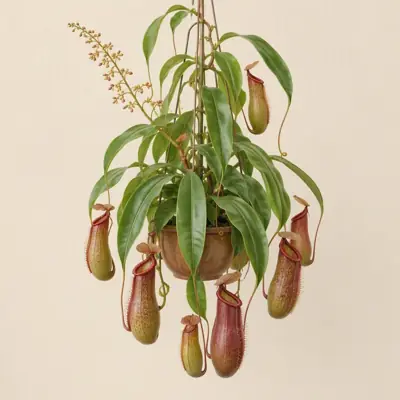
Nepenthes alata is a carnivorous climbing vine that forms hanging pitchers. It is an evergreen perennial.
Overview
Nepenthes alata is a carnivorous climbing vine that forms hanging pitchers. It is an evergreen perennial.
Origin and habitat
Sources differ on its circumscription: it is endemic to the Philippines, and under a narrower taxonomic concept it principally refers to populations in northern and central Luzon. Sources differ on its habitat, describing the more narrowly defined populations from higher elevations and also describing it in montane mossy forests in the Philippines, occasionally on soils formed from ultramafic rock. It is reported from a tropical, highland habitat.
Characteristics
Sources differ, but the mature height is reported at about 400–400 cm; the few available sources report a mature spread of about 10–50 cm. With suitable care, it is reported to extend its vines rapidly while gradually producing larger leaves and pitchers. The leathery leaves have winged petioles and narrow elliptic to oblanceolate or spatulate blades, and the leaves can be modified into lidded pitchers. Male and female flowers are reported to have different floral structures, and flowering may occur intermittently.
Light
Sources differ in describing suitable exposure as bright filtered light, partial sun, or bright indirect light; indoors, a bright window is suitable while overly strong direct sunlight should be avoided. It needs bright light.
Watering
Keep the well-drained medium moist and do not allow it to dry completely; regular misting can increase air humidity. The watering method is misting plus top watering, with the medium kept evenly moist.
Humidity and airflow
The few available sources report a preferred humidity range of about 60–100 %. It prefers high humidity and is reported to need moderate airflow.
Temperature and dormancy
The few available sources report a minimum temperature of about 15.6 °C. Sources differ on its hardiness classifications. It is reported to be frost tender; keep above freezing.
Growing medium and mounting
Use an acidic, low-nutrient, well-drained medium; sphagnum moss or a humus-rich, well-drained mix can be used, while RHS also lists loam. Sphagnum moss is a reported substrate type.
Feeding
For general Nepenthes cultivation, a slow-release chemical fertilizer is reported for regular use during the summer growth period, or a fast-acting liquid fertilizer may be applied more frequently. Nepenthes alata is reported to attract insects with nectar, causing them to fall into the pitchers and be digested.
Propagation
It can be propagated by stem cuttings or seed; general Nepenthes guidance uses vine sections with several nodes inserted into sphagnum moss and kept from drying in bright shade until they root.
Common problems
It may be affected by mealybugs, scale insects, and aphids. Sources differ on diseases: RHS considers disease generally uncommon, while NHK's general Nepenthes cultivation information reports that leaf spot may occur. Identification and labeling can be confused in the horticultural trade: plants formerly cultivated widely as N. alata may be N. graciliflora, while N. × ventrata and other hybrids may also be sold as N. alata. It does not tolerate frost or low temperatures and should be kept from freezing conditions.
Identification
Morphology and coloration vary considerably; pitchers range from green to red, with an enlarged lower portion and a nearly cylindrical upper portion. Under a narrower taxonomic concept, the core populations are those from northern and central Luzon with pitchers bearing conspicuous hairs.
Photos


Sources
- Wikipedia (en): Nepenthes alata — CC BY-SA 4.0 · link
- 維基百科:翼狀豬籠草 — CC BY-SA 4.0 · link
- Wikipedia (de): Nepenthes alata — CC BY-SA 4.0 · link
- Wikipedia (it): Nepenthes alata — CC BY-SA 4.0 · link
- Wikipedia (nl): Nepenthes alata — CC BY-SA 4.0 · link
- RHS Plants: Nepenthes alata — © RHS, facts only · link
- Tom's Carnivores: Nepenthes (genus-level) — © Tom's Carnivores, facts only · link
- NHK みんなの趣味の園芸 植物図鑑: Nepenthes alata — © NHK出版, facts only · link
- Top Tropicals catalog: Nepenthes alata — © Top Tropicals LLC (facts only) · link
- Tropical Pitcher Plants (Nepenthes spp.): Indoor Care, Growing Tips, & Plant Gui (hgic.clemson.edu) — facts only (§12) · link
- Nepenthes alata – California Carnivores (www.californiacarnivores.com) — facts only (§12) · link
- Tropical Pitcher Plant ‘Alata’ For Sale – Logee's Plants (www.logees.com) — facts only (§12) · link