
Neoregelia hybrid (Neoregelia hybrid)
Neoregelia hybrida is reported to be a small, rosette-forming epiphytic foliage plant that produces offsets from the base or stolons and forms clumps. It is reported to be an evergreen perennial; each rosette flowers once, after which the mother plant gradually dies while offsets continue its growth.
Overview
Neoregelia hybrida is reported to be a small, rosette-forming epiphytic foliage plant that produces offsets from the base or stolons and forms clumps. It is reported to be an evergreen perennial; each rosette flowers once, after which the mother plant gradually dies while offsets continue its growth.
Origin and habitat
Sources differ on its native range, describing it as South American or from tropical to subtropical America. It is reported to grow mainly as an epiphyte attached to forest tree trunks and branches, and the genus occurs naturally in South American rainforests. It is reported to occur in tropical to subtropical climates.
Characteristics
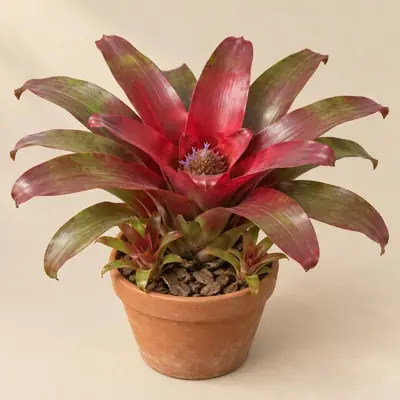
Sources differ, with the few available sources indicating a mature height of about 10–40 cm. The leaves are reported to be reddish purple; at genus level, they are arranged in rosettes and are usually relatively broad and flat, with margins that may have spines or teeth. The small flowers are reported to occur in the water-holding tubular cup at the center of the rosette, while the central or nearby leaves often turn red or become brightly colored during flowering.
Light
It is reported to need abundant bright light throughout the year; indoors, a well-lit position helps maintain leaf color, while strong direct sunlight may scorch the leaves.
Watering
From spring through autumn, it is generally watered from above to fill the central tank and keep water in it; in cold winter conditions, the accumulated water should be emptied. The potting medium is reported to need good drainage and aeration and may be allowed to dry between waterings.
Temperature and dormancy
It is generally frost tender; keep above freezing. Reported temperature guidance includes a lower and an upper temperature limit, with a stated cold minimum, but these claims are qualitative.
Growing medium and mounting
A highly aerated, well-drained medium is generally used, including sphagnum moss, coconut husk, bark, or orchid bark medium; soils prone to waterlogging and poor aeration are considered unsuitable.
Feeding
During the spring-to-autumn growing period, slow-release chemical fertilizer is reported to be applied periodically.
Propagation
Sources differ on details of propagation by division: offsets around the mother plant are separated and planted in an aerated medium such as sphagnum moss, while NHK recommends waiting until offsets are sufficiently developed and avoiding the cold season.
Common problems
Scale insects and spider mites are reported as possible pests, with NCSU also advising attention to mealybugs; standing water in outdoor rosettes may also become a breeding site for mosquitoes. Anthracnose, leaf blight, and leaf spot are reported as possible diseases, while excessive watering may cause root or crown rot. Insufficient light may cause vivid leaf color to fade or turn green, strong direct sunlight may scorch the leaves, and an overly wet medium may lead to rot. It is reported to have weak cold tolerance and strong heat tolerance, and cold conditions may require moving it to a protected indoor or greenhouse environment.
Identification
It is reported to be small, with reddish-purple leaves, abundant offsets, and a water-holding tubular cup formed at the center of the rosette.