
Neoregelia hybrid (Neoregelia hybrid)
Neoregelia hybrida is reported to be a tropical, epiphytic evergreen herb whose leaves form a rosette. It is reported to be perennial; each rosette flowers once and then gradually dies, usually after producing pups that replace it.
Overview
Neoregelia hybrida is reported to be a tropical, epiphytic evergreen herb whose leaves form a rosette. It is reported to be perennial; each rosette flowers once and then gradually dies, usually after producing pups that replace it.
Origin and habitat
It is reported from tropical South America, with some information describing its range more broadly as tropical to subtropical America. It is reported to inhabit rainforest canopies, usually growing epiphytically on the branches and trunks of forest trees in tropical to subtropical climates.
Characteristics
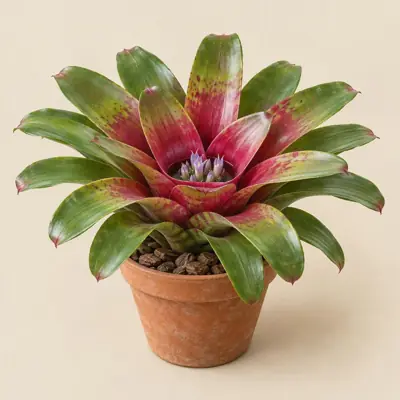
Few sources indicate a mature height of about 10–40 cm and a mature spread of about 0–91.44 cm. The leaves are reported to form a broad, relatively flat rosette and often show vivid red, purple, yellow, or variegated coloration; their margins may be spiny or toothed, and the central leaves often turn red around flowering. The flowers are reported to be small and borne in the water-holding tubular or cup-shaped center of the rosette, with the inflorescence close to the surface of the collected water.
Light
Bright indirect light is generally suitable, with ample bright light helping maintain leaf color while strong direct sunlight that can scorch the leaves should be avoided.
Watering
From spring through autumn, it is generally watered from above while water is kept in the central rosette tank; if temperatures fall in winter, the standing water is emptied. The growing medium is generally allowed to dry before watering again, and rainwater may be used in the central tank.
Temperature and dormancy
It is generally described as frost tender and should be kept above freezing.
Growing medium and mounting
An airy, well-drained growing medium such as bark-based orchid medium, sphagnum moss, or coconut husk is generally used, while persistently wet, poorly aerated conditions around the roots are avoided.
Feeding
During the spring-to-autumn growing period, slow-release chemical fertilizer is reported to be applied periodically.
Propagation
Sources differ in their details, but propagation is described as division by cutting pups formed after flowering from the parent plant and planting them separately once sufficiently developed; one account also advises avoiding cold periods.
Common problems
Reported pests include scale insects and spider mites, with mealybugs also noted; standing water in the centers of outdoor plants may also support mosquitoes. Reported diseases include anthracnose, leaf blight, leaf spot, and root or crown rot associated with overwatering. Insufficient light is reported to dull vivid leaf color or turn leaves green, while strong direct sunlight may scorch leaves; excessively wet medium can cause root or crown rot, and high humidity may encourage leaf spot to spread. It is generally described as having weak cold tolerance and strong heat tolerance, with direct outdoor cultivation in low-temperature conditions considered unsuitable once conditions become sufficiently cold.
Identification
Identification features are reported to include a water-holding tubular or cup-shaped structure at the center of the rosette, an inflorescence emerging from the center, and central and nearby leaves that often become conspicuously red or brightly colored during flowering.