
goldfish flower (Nematanthus gregarius)
Sources describe the habit differently, but Nematanthus gregarius is described as an evergreen, epiphytic subshrub with trailing to pendent growth that can be grown in hanging containers. It is perennial.
Overview
Sources describe the habit differently, but Nematanthus gregarius is described as an evergreen, epiphytic subshrub with trailing to pendent growth that can be grown in hanging containers. It is perennial.
Origin and habitat
Sources differ on the native range: it is native to Brazil, with one account specifying southeastern Brazil. In its native habitat it is an epiphyte, using trees or other plants for support rather than parasitizing them, and it also tends to creep or climb. It is associated with tropical environments and does not tolerate low temperatures well; in temperate climates it generally needs to overwinter in a greenhouse or indoors.
Characteristics
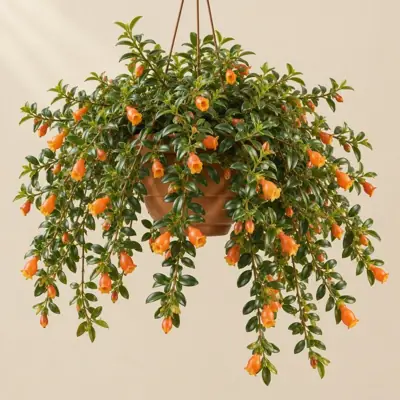
Mature plants reach 10–50 cm in height and 50–100 cm in spread. The leaves are small, simple, fleshy and thick, usually dark green with a glossy or waxy surface, and are described as ovate by a Spanish-language source. The orange flowers are tubular and inflated into a pouch-like shape, occurring singly or in small clusters and often described as resembling goldfish. Sources differ on flowering timing, with flowering mainly from late spring through summer but also possible at other times indoors or in mild climates; small orange fruits are reported to form and enable sexual reproduction.
Light
Provide bright, indirect light to partial sun, with ample light to encourage flowering while avoiding prolonged strong direct sunlight that can scorch the leaves.
Watering
Keep the growing medium slightly moist but well drained and avoid overwatering, as excessive moisture can cause root rot; soft water can be used for indoor cultivation.
Temperature and dormancy
The minimum temperature is 10 °C. It is classified in the stated USDA and RHS hardiness categories.
Growing medium and mounting
Use a loamy or sandy, acidic to neutral growing medium that is moist but well drained; a peat-free potting medium can be used indoors.
Feeding
It is reported to have modest feeding needs, and diluted liquid fertilizer for flowering plants can be applied with watering during the recommended feeding period.
Propagation
Sources differ on propagation guidance: stem, shoot-tip or root cuttings can be used, with different sources recommending different seasons for cuttings; commercial production also uses vegetative propagation.
Common problems
Aphids may attack, particularly on young shoots, and some sources also note mealybugs. Few known disease problems are generally reported. Overwatering is reported to cause root rot, while prolonged exposure to strong full sun can scorch the leaves. It is sensitive to low temperatures and needs to be moved indoors or into a protected greenhouse during cold periods in temperate climates.
Identification
Nematanthus gregarius is distinguished by fleshy, glossy dark green leaves, orange inflated tubular pouch-like flowers resembling small goldfish, and conspicuously trailing, pendent stems.
Photos

