
blue myrtle-cactus (Myrtillocactus geometrizans)
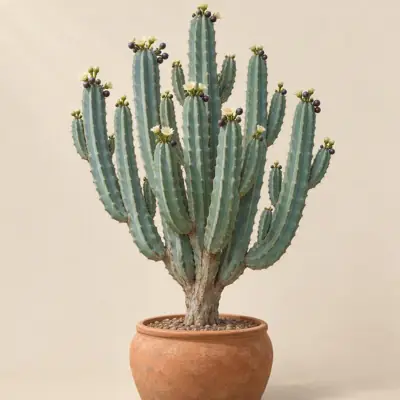
Myrtillocactus geometrizans is a spiny, succulent, evergreen, perennial columnar cactus with a shrub- to tree-like habit; mature plants branch heavily and often form a candelabra-like crown.
Overview
Myrtillocactus geometrizans is a spiny, succulent, evergreen, perennial columnar cactus with a shrub- to tree-like habit; mature plants branch heavily and often form a candelabra-like crown.
Origin and habitat
Sources differ on its native range, describing Myrtillocactus geometrizans as endemic to Mexico and widespread there, primarily in central regions with extensions northward and into some southern states. It occurs in xeric scrub, tropical or dry deciduous forest, and less often grassland, generally in arid to semi-arid settings; some sites have gypsum or limestone soils with relatively high salinity. Its native environment is predominantly arid to semi-arid and warm; a single source also reports a distinct rainy period and describes the regional temperature and rainfall.
Characteristics
Sources differ, but mature height is reported at about 400–500 cm, while the few sources for mature spread differ and report about 0–500 cm. It grows quickly. Sources differ in their descriptions of the small flowers, which range from white or creamy white to greenish white or yellowish white and last about a day or less. Sources differ on flowering season and on fruit descriptions; the berries are described as dark red, dark purple, purple-blue to blue when ripe, with juicy flesh that some sources describe as sweet.
Light
Myrtillocactus geometrizans takes full sun and can be grown in full sun or bright, strong light.
Watering
Water moderately during the growing period, supplying water normally from mid-spring to early autumn and keeping it nearly dry at other times; water again after the surface of the growing medium has dried.
Humidity and airflow
It is generally reported to prefer low humidity.
Temperature and dormancy
Sources differ on minimum temperature, with the few available sources indicating about 0 °C. Sources also differ on its hardiness classification. It is generally reported to be frost tender; keep above freezing, and it is generally reported as not frost tolerant. It rests cool in winter with a little water; a single specialist source reports a cold minimum of about -4 °C, so sources are few.
Growing medium and mounting
Use a well-drained cactus medium; horticultural sources support loamy or sandy soils under acidic, neutral, or alkaline conditions. It needs a fast-draining mix.
Feeding
A single source reports that a low-nitrogen fertilizer can be applied monthly from mid-spring to early autumn.
Propagation
Myrtillocactus geometrizans can be propagated by seed or cuttings; stem cuttings are suited to summer or hot weather and should be kept relatively dry while rooting.
Common problems
It is reported to be susceptible to mealybugs and generally to have no notable disease problems. It is sensitive to frost and freezing, and exposure to freezing conditions should be avoided in cold regions. Maintain good drainage, allow the growing medium to dry thoroughly after watering, and limit water in winter.
Identification
Sources differ in the details, but the stems are described as blue-green to blue-gray with a whitish bloom and conspicuous ribs; mature plants branch profusely into a candelabra-like form, and each areole may bear from a few to several spines.
Photos


Sources
- Wikipedia (en): Myrtillocactus geometrizans — CC BY-SA 4.0 · link
- Wikipedia (de): Myrtillocactus geometrizans — CC BY-SA 4.0 · link
- Wikipedia (fr): Myrtillocactus geometrizans — CC BY-SA 4.0 · link
- Wikipedia (es): Myrtillocactus geometrizans — CC BY-SA 4.0 · link
- LLIFLE Encyclopedia of living forms: Myrtillocactus geometrizans — CC BY-SA · link
- Useful Tropical/Temperate Plants: Myrtillocactus geometrizans — CC BY-NC-SA 3.0 (facts only) · link
- RHS Plants: Myrtillocactus geometrizans — © RHS, facts only · link
- The Succulent Plant Page: Myrtillocactus (genus-level) — © R.J. Hodgkiss, facts only · link
- Top Tropicals catalog: Myrtillocactus geometrizans — © Top Tropicals LLC (facts only) · link
- Myrtillocactus geometrizans | Giromagi cactus and succulents | Buy plants online (www.giromagi.com) — facts only (§12) · link
- PUKUBOOK: Myrtillocactus geometrizans — CC BY-NC (facts only) · link