
Armenian grape hyacinth (Muscari armeniacum)
Muscari armeniacum is a small bulbous perennial herb.
Overview
Muscari armeniacum is a small bulbous perennial herb.
Origin and habitat
Its native range mainly extends from the eastern Mediterranean through southeastern Europe, Asia Minor, and the Caucasus, including the Balkan Peninsula, Greece, Turkey, Armenia, the Caucasus, and Transcaucasia. It is reported from woodland, grassland, forest margins, juniper scrub, and rocky or gravelly grassy slopes, on substrates including limestone, serpentine, and shale. It is suited to temperate environments with a cool growing season; when cultivated at low elevations in Taiwan, hot, humid summers are unfavorable for normal bulb survival through summer and for meeting its cold dormancy requirement.
Characteristics
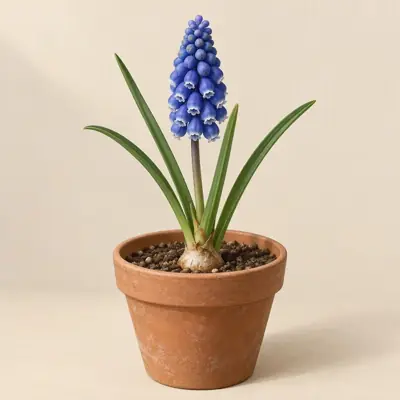
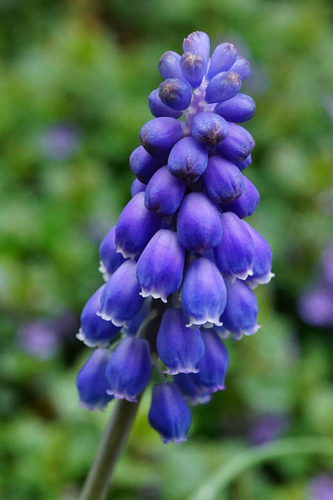
Mature plants are about 10–20 cm tall, although sources differ, and spread about 0–10 cm according to few sources. The narrow to linear leaves arise from the base, are green to gray-green, and are often arching or spreading; mature bulbs can produce new leaves again in autumn. Sources differ in their descriptions of the flowers: dense racemes stand upright on short flower stalks, with typical flowers ranging from deep violet-blue to bright blue, often with a white mouth or margin and an ovoid to bell-like shape; horticultural varieties also include white, pale blue, and pale pink flowers, and some strains are fragrant. Flowering occurs in spring and lasts for a period of several weeks.
Light
It grows in full sun to partial shade and needs ample light while growing; indoors it can be placed by a bright window with indirect light, while insufficient light can cause leaves to yellow and become limp and flower clusters to become elongated.
Watering
During the growing season, keep conditions moderately moist but well drained and water after the surface of the potting medium dries; reduce watering as the leaves begin to die back. The plant can tolerate summer drought but still needs moisture while actively growing.
Temperature and dormancy
It is reported to have an RHS hardiness classification.
Growing medium and mounting
Ordinary well-drained soil is suitable, including chalk, clay, loam, and sand, and the plant can grow in acidic, neutral, or alkaline soils with conditions ranging from moist but well drained to well drained.
Propagation
Propagation by separating offsets or dividing bulbs is recommended; seed propagation is also possible but may take several years to reach flowering. In Taiwan, propagation is mainly by bulbs.
Common problems
It is reported to be browsed occasionally by deer and generally has few other notable pest or disease problems. It naturalizes and spreads readily and may become weedy and crowd out other plants in suitable conditions; insufficient light can cause limp, yellowing leaves and elongated flower clusters. It prefers cool, moderately moist conditions during the growing season and mature plants tolerate summer drought, while hot, humid summers in lowland Taiwan make it difficult for bulbs to survive through summer.
Identification
Muscari armeniacum has an underground bulb, narrow basal leaves, and dense, grape-like blue-violet flower clusters; typical flowers are bright blue to deep violet-blue with a white mouth. It resembles Muscari neglectum, but has brighter, sky-blue flowers without a white powdery coating.
Photos


Sources
- Wikipedia (en): Muscari armeniacum — CC BY-SA 4.0 · link
- Wikipedia (de): Armenische Traubenhyazinthe — CC BY-SA 4.0 · link
- Wikipedia (fr): Muscari armeniacum — CC BY-SA 4.0 · link
- GBIF descriptions: Euro + Med-Checklist Notulae, 17 — per dataset · link
- NC State Plant Toolbox: Muscari armeniacum — copyright (facts only) · link
- 農業知識入口網 植物圖鑑: Muscari armeniacum — © MOA, facts only · link
- RHS Plants: Muscari armeniacum — © RHS, facts only · link
- USDA PLANTS Database: Muscari armeniacum — Public domain (US Government work) · link