
Window-Leaf Monstera (Monstera obliqua)
Monstera obliqua is a slender climbing or creeping plant that can be partly epiphytic; young plants may creep along the ground, while mature plants may climb trees, shrubs, and slender branches. It is reported to be evergreen.
Watch: Monstera vs Philodendron vs Alocasia vs Anthurium
Overview
Monstera obliqua is a slender climbing or creeping plant that can be partly epiphytic; young plants may creep along the ground, while mature plants may climb trees, shrubs, and slender branches. It is reported to be evergreen.
Origin and habitat
Sources differ on its documented native range in Neotropical America, with accounts covering Costa Rica to Bolivia, the Guianas, and Trinidad and Tobago, while other records specifically include Panama, Bolivia, and northern Brazil. Sources differ in describing its habitat within moist Neotropical forests: it may climb young trees, shrubs, and slender tree branches, grow epiphytically on other aroids, and use small, short-lived substrates that larger Monstera have more difficulty occupying. It occurs in tropical, warm, humid environments.
Characteristics
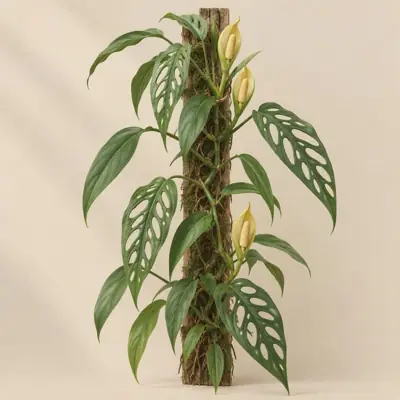
A single source reports a mature height of about 100–150 cm and a mature spread of about 50–100 cm, so sources are few for these measurements. It is generally described as slow-growing. Sources differ on the highly variable leaves, which can range from lance-shaped to broadly ovate, with thin membranous to somewhat leathery blades, often asymmetric bases of several forms, and anything from no fenestrations to many; Central American material may have absent or only weakly developed fenestrations. Sources differ on details of the typical aroid spathe and spadix, while the mature fruiting structure is dark orange and bears separate, nearly spherical berries; flowering has also been recorded during part of the year.
Light
Monstera obliqua grows in bright indirect light to partial shade and should be kept from prolonged strong direct sunlight.
Watering
During active growth, keep the growing medium moderately moist but well drained and water after the surface dries slightly; in winter, keep it only slightly moist and avoid prolonged waterlogging.
Humidity and airflow
Monstera obliqua prefers high humidity.
Temperature and dormancy
Hardiness classifications are reported by RHS and Top Tropicals. It is generally frost tender; keep above freezing.
Growing medium and mounting
Use a fertile, well-drained growing medium that retains some moisture; RHS recommends a peat-free, loam-based medium, and the plant can adapt to acidic, neutral, or alkaline conditions. It has aerial and soil roots and suits an airy mix.
Feeding
A single source recommends applying a balanced liquid fertilizer monthly during active growth.
Propagation
A single source reports propagation by seed, root-tip or leaf cuttings, as well as layering in summer.
Common problems
Scale insects and glasshouse red spider mites are reported as possible pests, while RHS generally reports no notable disease problems. Strong direct light can scorch the thin leaves, insufficient light can cause yellowing or wilting, and low humidity can cause dry, scorched leaf margins. It is sensitive to frost and freezing conditions, and RHS recommends a sheltered position.
Identification
Sources differ in their descriptions, but Monstera obliqua is slender, has highly variable leaves that do not necessarily have many fenestrations, bears mature fruits that are nearly spherical and separate from one another, and can form inflorescences in groups; heavily perforated leaves characterize only some individuals or forms of the species.
Photos


Sources
- GBIF Backbone: Monstera obliqua Miq. — CC BY 4.0 · link
- Wikipedia (en): Monstera obliqua — CC BY-SA 4.0 · link
- Wikipedia (fr): Monstera obliqua — CC BY-SA 4.0 · link
- GBIF descriptions: Catálogo de Plantas y Líquenes de Colombia; Plantas vasculares que se han reportado en los bosques s — per dataset · link
- RHS Plants: Monstera obliqua — © RHS, facts only · link
- NHK みんなの趣味の園芸 植物図鑑: Monstera (genus-level) — © NHK出版, facts only · link
- Top Tropicals catalog: Monstera obliqua — © Top Tropicals LLC (facts only) · link
- Monstera Obliqua: How To Grow And Care (houseplantcentral.com) — facts only (§12) · link
- Monstera Obliqua Care: Humidity, Light & Propagation Tips | MyGreenScape (mygreenscape.ca) — facts only (§12) · link
- Monstera obliqua (Peru) | Foliage Factory (foliage-factory.com) — facts only (§12) · link